What Is Color Temperature in Photography?
Author: Fiat Lux Guides Editorial Team Reviewer: Fiat Lux Guides Editorial Team Most recently reviewed First published Filed under Color and White Balance
Color temperature is a measurement in Kelvin (K) that describes the hue of a light source along the amber-to-blue axis by comparing it to an idealized heated blackbody radiator. Lower Kelvin numbers around 2700K to 3200K appear warm orange-yellow, while higher values around 5200K to 8000K appear neutral daylight to cool blue.
Belongs to the guide: Color Temperature and White Balance Explained
Understanding what is color temperature lets you match your camera’s color rendering to any light source on set—whether you are shooting beside a north-facing window, under studio LEDs, or with a speedlight. In our Kelvin and white-balance overview pillar guide, we cover the full workflow from capture to matching multiple fixtures. Here, we focus on what the Kelvin scale actually measures, why LEDs use Correlated Color Temperature (CCT), and how camera manuals map common lighting conditions to Kelvin values.
The physics behind the Kelvin scale

The International Commission on Illumination (CIE) defines colour temperature ($T_c$) as the temperature of a Planckian (blackbody) radiator whose radiation has the same chromaticity as a given light stimulus, expressed in kelvin (K). A theoretical blackbody absorbs all incoming light and, when heated, emits a smooth, continuous spectrum whose color depends solely on its absolute temperature.
As temperature rises, the peak wavelength shifts from red-orange (around 2000 K–3000 K), through neutral white (around 5200 K–6500 K), to pale blue (above 7000 K). That creates a classic photography paradox: lower Kelvin numbers look visually “warm” (amber), while higher Kelvin numbers look visually “cool” (blue), even though the higher Kelvin number corresponds to a physically hotter radiator.
True color temperature vs Correlated Color Temperature (CCT)
Incandescent and halogen bulbs produce light by heating a metal filament, so their output tracks the blackbody curve closely. Modern photo and video LEDs, fluorescent tubes, and discharge lamps do not work by heating a filament to incandescence; their chromaticity coordinates often sit slightly off the blackbody curve (the Planckian locus).
To assign a Kelvin rating to those sources, lighting engineers use Correlated Color Temperature (CCT), defined by the CIE e-ILV as the temperature of the Planckian radiator whose chromaticity is nearest to the test light source on a uniform chromaticity diagram.
Because two LEDs can share the exact same 5600 K CCT rating while one leans slightly green and the other slightly magenta, the US Department of Energy solid-state lighting guidelines pair CCT with a second metric called $D_{uv}$ (distance from the Planckian locus). For camera work, that means Kelvin alone only tells you the amber-to-blue balance; green/magenta shifts require your camera’s Tint or G–M fine-tuning control.
Reference Kelvin values from camera manuals
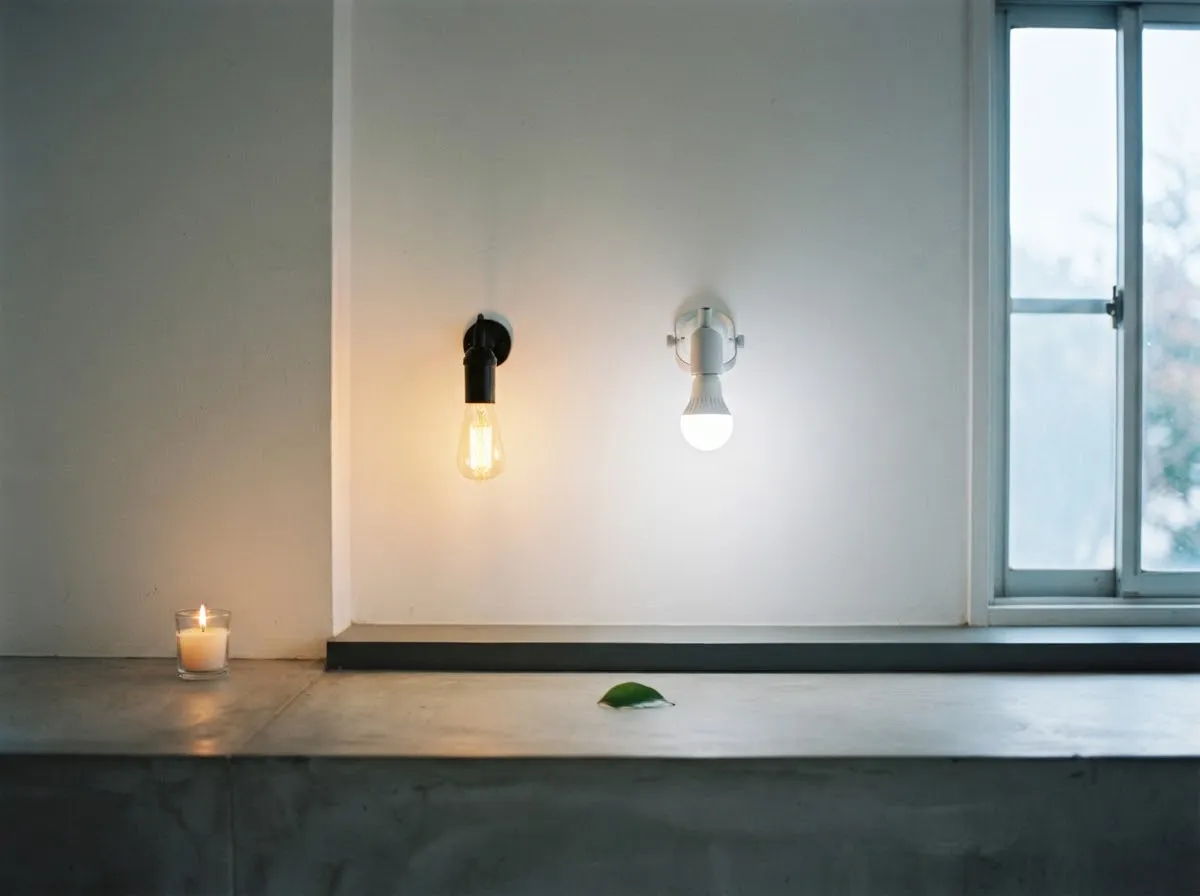
Camera makers publish approximate Kelvin values for each white-balance preset so you can match lights to your camera or dial in a manual value. The table below lists documented values from the Canon EOS-1D X Mark III manual and the Nikon D780 manual:
| Light Condition / Preset | Canon EOS-1D X Mark III (approx.) | Nikon D780 (approx.) | Visual Character on Neutral WB |
|---|---|---|---|
| Sodium-vapor / Warm lamp | — | 2700 K (Sodium-vapor) | Deep amber / orange |
| Incandescent / Tungsten | 3200 K | 3000 K | Warm yellow-orange |
| Warm-white fluorescent | — | 3000 K | Warm indoor tube |
| White fluorescent | 4000 K | 3700 K (White) / 4200 K (Cool-white) | Neutral-warm to slightly cool indoor |
| Direct sunlight / Daylight | 5200 K | 5200 K | Neutral white |
| Flash / Studio strobe | ~6000 K (without color temp transmission) | 5400 K | Neutral daylight |
| Cloudy / Overcast | 6000 K (Cloudy, twilight, sunset) | 6000 K | Slightly cool |
| Daylight fluorescent | — | 6500 K | Crisp cool white |
| Shade | 7000 K | 8000 K | Cool blue |
When you want to match two lights on set—such as a bi-color LED panel and a window—use our Kelvin color temperature chart and light matcher to inspect approximate blackbody swatches and calculate the shift between sources.
Why mireds matter more than raw Kelvin steps
A 1000 K jump at the warm end of the scale looks dramatically different from a 1000 K jump at the cool end. As explained in the Nikon D780 white balance manual, changing color temperature from 3000 K to 4000 K produces a much larger visual shift than changing from 6000 K to 7000 K.
Lighting technicians solve this non-uniformity with mireds (micro-reciprocal degrees, or reciprocal megakelvin $\text{MK}^{-1}$), calculated as:
$$\text{Mired} = \frac{1{,}000{,}000}{T\text{ (in Kelvin)}}$$
- 3000 K = $1{,}000{,}000 / 3000 \approx 333\text{ mireds}$
- 4000 K = $1{,}000{,}000 / 4000 = 250\text{ mireds}$ (a shift of 83 mireds)
- 6000 K = $1{,}000{,}000 / 6000 \approx 167\text{ mireds}$
- 7000 K = $1{,}000{,}000 / 7000 \approx 143\text{ mireds}$ (a shift of only 24 mireds)
Because equal mired steps track color change more evenly than equal Kelvin steps, color-compensation filters are specified in mired shifts rather than raw Kelvin differences.
Applying color temperature to your camera workflow
Knowing a light’s Kelvin value is only half the equation; the other half is telling your camera what “white” should look like under that light. Next, read white balance basics to see when to trust Auto White Balance versus locking a manual Kelvin value, or check mixed lighting and color casts when two different Kelvin sources hit the same subject. If you are shooting by a window, our daylight photography basics hub covers how daylight shifts from sunrise to shade. For details on how we source and verify technical standards, see our review standards.
Common questions
Why are warm lights lower Kelvin and cool lights higher Kelvin?
The Kelvin scale comes from the physical temperature of a heated blackbody radiator. As an object heats up, it first glows dull red, then orange-yellow around 3000 K, neutral white around 5200 K to 6500 K, and bluish white above 7000 K. Artists call lower Kelvin tones 'warm' and higher Kelvin tones 'cool' by visual association, even though higher Kelvin means a physically hotter radiator.
What is the difference between color temperature and correlated color temperature (CCT)?
True color temperature applies only to thermal radiators like incandescent filaments whose spectrum sits directly on the Planckian locus. LEDs and fluorescent tubes emit light through non-thermal processes, so their chromaticity often sits slightly above or below that curve; their nearest match on the curve is called Correlated Color Temperature (CCT).
What color temperature is natural daylight on a camera?
Camera manufacturers calibrate their Daylight preset near 5200 K, as listed in both Canon and Nikon manuals. Overcast skies and open shade shift cooler, with camera presets typically mapping Cloudy around 6000 K and Shade between 7000 K and 8000 K.
Does color temperature measure green or magenta tints?
No, Kelvin only measures color along the amber-to-blue axis. Green or magenta shifts—common in fluorescent tubes and lower-quality LEDs—occur perpendicular to the Planckian locus (measured as Duv) and require a separate Tint or Green-Magenta fine-tuning adjustment in your camera. Setting the right Kelvin value alone will not remove a green or magenta cast, so check the tint control as well when skin tones look off.
Why does a 1000 K change look bigger at 3000 K than at 7000 K?
The same Kelvin step causes a larger color shift at lower temperatures than at higher ones. Nikon's manual explains the mired scale (the inverse of color temperature multiplied by 10^6): the same 1000 K step is 83 mired from 3000 K to 4000 K but only 24 mired from 6000 K to 7000 K, so equal mired steps track color shifts more evenly than equal Kelvin steps.
What we checked
- CIE e-ILV 17-23-067 — Colour temperature, checked 2026-11-14 (cie.co.at)
- CIE e-ILV 17-23-068 — Correlated colour temperature (CCT), checked 2026-11-14 (cie.co.at)
- US Department of Energy — Recommended Method for Determining Correlated Color Temperature and Distance from the Planckian Locus, checked 2026-11-14 (energy.gov)
- Canon EOS-1D X Mark III Manual — White Balance Presets and Kelvin Table, checked 2026-11-14 (cam.start.canon)
- Nikon D780 Online Manual — White Balance and Mired Scale, checked 2026-11-14 (onlinemanual.nikonimglib.com)
You might also like
- Color Temperature and White Balance Explained
Learn Kelvin color temperature, camera white balance presets, green/magenta tint, CRI vs TLCI, and how to prevent mixed-lighting color casts.
- CRI and TLCI Explained: Color Accuracy of Lights
Understand what CRI and TLCI measure, why CRI can miss red skin tones on LEDs, and what TLCI scores mean for photo and video.
- Custom White Balance with a Gray Card
How to set custom white balance in-camera with a gray or white card for accurate skin tones under LEDs, window light, and mixed lighting.
- Kelvin vs Tint: Fixing Green and Magenta Color Casts
Learn the difference between Kelvin color temperature and green-magenta tint (Duv), why LEDs shift green, and how to fix color casts.
- Lighting Gels: CTO and CTB for Color Matching
Match tungsten, daylight, and LED sources using CTO and CTB lighting gels, mired shift math, and light transmission loss.
- Matching LED Lights to Daylight
How to match LED video and photo lights to window daylight using Kelvin presets, mired shifts, and camera white balance without mixed color casts.