The Inverse Square Law of Light for Photographers
Author: Fiat Lux Guides Editorial Team Reviewer: Fiat Lux Guides Editorial Team Most recently reviewed First published Filed under Setups and Exposure
The inverse square law states that light intensity from a point source drops proportionally to the square of the distance from the source (E proportional to 1/d^2). Doubling the distance reduces light to one-fourth (2 stops darker), while moving a light closer increases falloff contrast between your subject and the background.
Belongs to the guide: Three-Point Lighting Explained for Beginners
The inverse square law is the single most practical physics rule in key-fill-backlight basics and studio photography because it predicts both exposure changes and how fast brightness drops from subject to background. Once you understand why doubling a light’s distance cuts brightness to one-fourth, you can darken a cluttered wall, balance two people in the same frame, or adjust flash power without guessing.
Instead of memorizing dozens of setups, you only need one simple ratio—and you can run any distance change directly through our light distance exposure calculator.
The formula and why light drops so fast
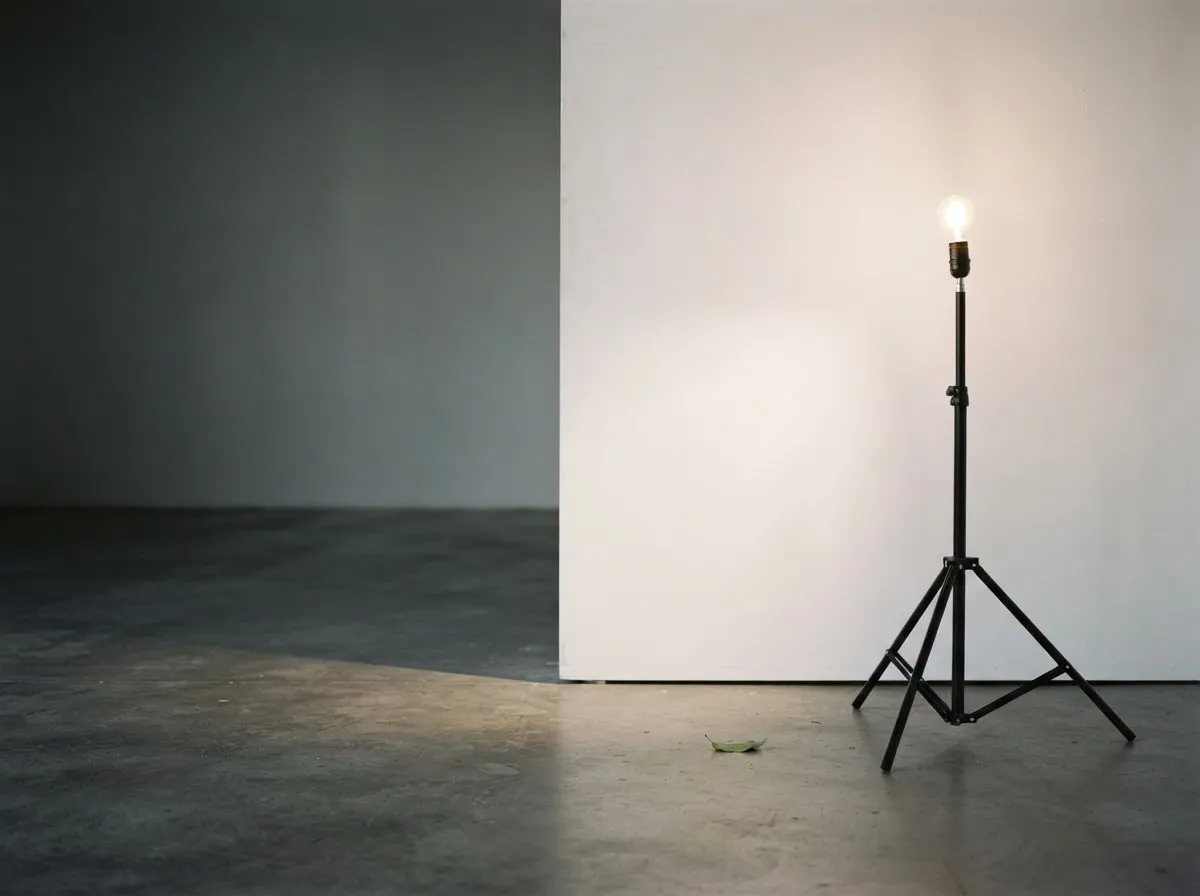
As documented in HyperPhysics and OpenStax Astronomy, light radiating from an idealized point source spreads outward across the surface of an expanding sphere. Because a sphere’s surface area grows with the square of its radius, the same total light energy covers 4 times the area at 2× distance and 9 times the area at 3× distance.
$$\frac{E_2}{E_1} = \left(\frac{d_1}{d_2}\right)^2$$
In this equation, $E_1$ and $E_2$ are the illuminance values at distances $d_1$ and $d_2$. To convert that brightness ratio into camera exposure stops ($\Delta \text{EV}$):
$$\Delta \text{EV} = 2 \cdot \log_2\left(\frac{d_1}{d_2}\right)$$
Because 1 stop equals a factor of 2 in light intensity, changing distance by $\sqrt{2}$ ($\approx 1.41$) changes exposure by exactly 1 stop.
Distance-to-stops reference table
If you start with a correct exposure at 1 meter, moving the light back produces rapid, predictable drops in brightness:
| Distance from light | Relative illuminance | Change in stops (EV) | Flash power needed to compensate |
|---|---|---|---|
| 1.0 m | 100% (1) | Baseline (0 EV) | 1/8 power |
| 1.4 m ($\approx \sqrt{2}$) | 50% (1/2) | −1 stop | 1/4 power |
| 2.0 m | 25% (1/4) | −2 stops | 1/2 power |
| 2.8 m ($\approx 2\sqrt{2}$) | 12.5% (1/8) | −3 stops | 1/1 (full power) |
| 4.0 m | 6.25% (1/16) | −4 stops | +1 stop ISO or aperture needed |
Notice how manual flash power steps match stops one-for-one. In Canon’s Speedlite EL-1 specifications, stepping from 1/1 power down to 1/2 power reduces the Guide Number at 50mm (ISO 100) from 36.6 m to 25.9 m—a factor of $1/\sqrt{2}$, or exactly 1 stop less light.
Worked example: moving a speedlight back for a wider shot
Suppose you expose a portrait properly at f/8 with a manual speedlight at 2 meters, set to 1/2 power (ISO 100). You step the light stand back to 4 meters to keep it out of a wider frame.
- Compute the intensity ratio: $(d_1 / d_2)^2 = (2 / 4)^2 = (0.5)^2 = 0.25$ (one-fourth as much light).
- Convert to stops: $2 \cdot \log_2(2 / 4) = 2 \cdot (-1) = -2\text{ stops}$.
- Compensate at the camera or flash: To keep the same exposure, you need +2 stops. Because the flash is already at 1/2 power, turning it up to 1/1 power only gives +1 stop; you must also open the lens 1 stop from f/8 to f/5.6 (or raise ISO from 100 to 200).
For more on how f-numbers, ISO, and flash power trade off in stops, see exposure basics for lighting.
How falloff controls background brightness
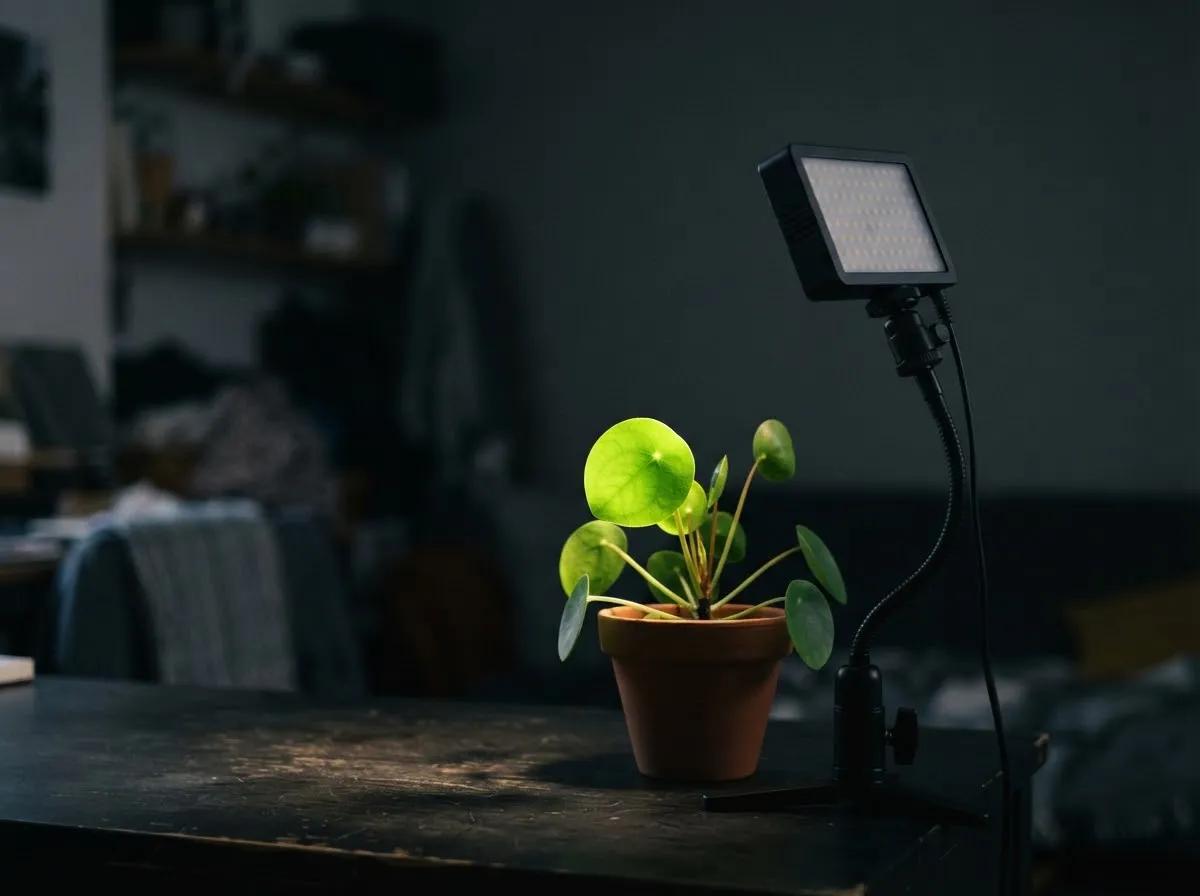
The inverse square law is also a creative tool for controlling how bright or dark your background looks relative to your subject—without adding extra flags or gobos.
- Light close to subject = fast falloff: If your key light is 1 meter from your subject and the wall is 2 meters behind the subject (3 meters from the light), the wall receives $(1 / 3)^2 = 1/9$ as much light as the subject (over 3 stops darker).
- Light far from subject = even illumination: If you move that same light back to 4 meters from the subject (6 meters from the wall), the wall receives $(4 / 6)^2 = 4/9$ as much light as the subject (just over 1 stop darker).
This is why moving a light closer darkens a distracting background, while moving a light farther away helps illuminate a group of people standing at slightly different distances from the fixture.
When the inverse square law does not behave like a point source
The $1/d^2$ formula models an idealized point source radiating freely in open space. Two real-world setups deviate from it:
- Very large sources up close: A big softbox or wide window placed right next to a subject wraps light from many angles at once, so brightness drops more gradually over the first few centimeters than a bare bulb does. As distance grows larger than the modifier itself, falloff converges back toward the inverse square curve.
- Reflective walls in small rooms: White walls and ceilings bounce stray light back onto the subject and background, reducing the contrast you would measure outdoors or in a large dark studio.
Pair distance control with source size by reading contrast between hard and soft light and common lighting mistakes. Our review standards explains how we verify formulas and manufacturer specs across every guide.
Common questions
What is the inverse square law of light in plain English?
The inverse square law means that as you move a small light source farther from your subject, the light spreads out over a much larger area and drops in brightness fast. Specifically, doubling the distance cuts the light hitting your subject to one-quarter of its original intensity, which equals a 2-stop loss in camera exposure.
How many stops of light do you lose when you double the distance?
Doubling the distance between a point light source and your subject reduces illuminance to one-fourth, which is a loss of 2 full stops of exposure. Each stop represents a factor of 2 in light intensity, so to lose or gain just 1 stop, you multiply or divide the distance by the square root of 2 (about 1.41).
Why does moving a light closer make the background darker?
Moving a light closer to your subject increases the relative distance ratio between the subject and the background. If the light is 1 meter from your subject and 3 meters from the wall, the wall receives one-ninth as much light as the subject. If you back the light up to 4 meters, the wall at 6 meters is only 1.5 times farther away, so both receive much more even illumination.
Does the inverse square law apply to large softboxes and windows?
Strictly speaking, the inverse square law models an idealized point source in open space. Large modifiers like big softboxes or wide windows placed very close to a subject fall off more gradually than the pure 1/d^2 formula predicts, though light still drops off rapidly as you move several source-widths away.
How do you calculate the new aperture when you move a flash?
You can calculate the change in stops using the formula dEV = 2 * log2(d1 / d2), or use a light's Guide Number at ISO 100 by dividing the Guide Number by the new distance. If you double the distance from 2 meters to 4 meters, you lose 2 stops and must open your aperture by 2 stops (for example, from f/8 to f/4) to keep the same exposure.
What we checked
- HyperPhysics: Inverse Square Law for Light, checked 2026-11-14 (hyperphysics.gsu.edu)
- OpenStax Astronomy 2e: Ch. 5 Summary (Inverse Square Law), checked 2026-11-14 (openstax.org)
- Canon Speedlite EL-1 Manual: Guide Number Specifications, checked 2026-11-14 (cam.start.canon)
You might also like
- Three-Point Lighting Explained for Beginners
Learn three-point lighting—key light, fill light, and backlight—plus how source size controls shadow softness and how distance and stops control exposure.
- Common Lighting Mistakes in Photo and Video
Spot and fix the most common photo and video lighting mistakes: mixed color casts, flat on-axis light, harsh overhead shadows, and distance falloff.
- Exposure Basics for Lighting: Stops, ISO, Aperture, Power
Understand how stops of light connect aperture, shutter speed, ISO, and flash or LED power so you can adjust lighting exposure accurately.
- Hard Light vs Soft Light: What Changes the Shadows
Compare hard light vs soft light in photography and video: how source size, distance, and penumbra geometry control shadow edge softness.
- Headshot Lighting at Home
Set up clean headshot lighting at home with a window or a single LED or strobe, covering light angle, background separation, and shadow fill.
- Key-to-Fill Ratio Explained
Learn what key-to-fill lighting ratios mean in f-stops, how 2:1, 4:1, and 8:1 contrast looks on camera, and how to measure ratios with a light meter.