Continuous LED Lights for Beginners
Author: Fiat Lux Guides Editorial Team Reviewer: Fiat Lux Guides Editorial Team Most recently reviewed First published Filed under Lighting Gear
Continuous LED lights stay lit while you compose and shoot, letting you preview shadows, reflections, and exposure directly through your viewfinder or on a video monitor. Unlike flash units, LEDs support both still photography and video, and quality fixtures list CRI and TLCI scores of 95 or higher alongside adjustable dimming and color temperature.
Belongs to the guide: LED vs Strobe vs Speedlight: What to Start With
Checked by Fiat Lux Guides’ editorial desk against the cited sources.
If you are deciding what lighting gear to buy first, our LED vs strobe vs speedlight pillar guide lays out the main trade-offs. Continuous LED lights stand out for one immediate reason: what you see is what you get. Because an LED stays illuminated while you compose, you can watch shadows move across a face, check reflections in eyeglasses, and let your camera’s live exposure meter guide your settings—for both still photos and video.
How Continuous LED Lights Differ From Flash
Unlike a speedlight or studio strobe that fires a brief burst of light during the shutter’s open window, a continuous LED runs at a steady brightness level. That difference shapes every part of a shoot:
- Works for video and stills: Flash cannot light continuous video frames, whereas a flicker-free LED lights interviews, YouTube videos, tutorials, and still portraits with the same setup.
- Real-time shadow preview: Moving an LED a few inches left or right immediately shows how the shadow edge shifts on your subject, removing the trial-and-error test shots required with entry-level flash.
- Lower peak output: Continuous fixtures deliver less instantaneous light than a flash of similar size and price. When shooting stills with an LED, you typically use wider apertures, slightly higher ISO settings, or slower shutter speeds than you would with a strobe—or place the light closer to your subject.
For a deeper look at flash alternatives, compare on-camera flash versus studio flash.
Main Types of Continuous LED Lights
Beginners usually encounter three category shapes when shopping for photo and video LEDs:
1. Flat LED Panels
Flat LED panels arrange dozens or hundreds of individual LEDs across a rectangular board, often with a built-in frosted plastic cover. They are thin, lightweight, and easy to pack into a backpack or mount on a compact stand for desk setups and video calls. Because the emitters are already spread over a rectangle, a panel produces somewhat softer light than a bare bulb—though a small panel still acts like a relatively small source once placed more than a meter away. Adding a custom panel softbox helps, though panels cannot accept standard round studio modifiers without specialized brackets.
2. COB (Chip-on-Board) Point-Source LEDs
A COB LED concentrates high-output diodes into a single dense cluster behind a glass dome, mimicking the point-source geometry of a studio strobe head. Most studio COB fixtures feature a Bowens mount (as seen on fixtures like the Aputure LS 600d), which lets you twist on standard softboxes, octaboxes, beauty dishes, umbrellas, and Fresnel lenses. Because a COB light concentrates its beam before hitting a diffuser, it gives you far more shaping control than a flat panel.
3. LED Tubes and Ring Lights
LED tubes are cylindrical fixtures useful for rim lights, hair lights, or practical accents visible inside a video frame. Ring lights wrap emitters in a circle around the camera lens, producing even, shadowless front light and circular catchlights—popular for makeup and talking-head clips, though less flexible for directional side-lit portraits.
Daylight vs. Bi-Color vs. RGB LEDs
LED fixtures fall into three color-control categories:
- Daylight-balanced (fixed ~5600 K): Outputs a single color temperature matched to midday daylight and window light. Because every diode on the board is tuned to the same spectrum, daylight fixtures generally deliver higher maximum brightness than a bi-color unit of the same wattage.
- Bi-color (adjustable range varies by model): Combines warm tungsten-balanced diodes and cool daylight-balanced diodes. Dialing between them lets you match warm indoor lamps (near 3000 K per Nikon’s white balance reference) or cool window light without clipping color gels onto the front.
- RGB / RGBWW: Adds red, green, and blue emitters for colored background washes and creative effects, alongside white emitters for normal skin tones.
Check how Kelvin settings map to camera white balance using our Kelvin color temperature chart.
What CRI, TLCI, and Lux Numbers Actually Mean
Manufacturer spec sheets list several photometric numbers. Focusing on three of them keeps you from buying a dim light with muddy skin tones:
- CRI (Color Rendering Index): Scores how accurately a light reveals colors compared with a reference light source for the human eye, on a scale up to 100. Aim for CRI ≥ 95 for portraits and product work.
- TLCI (Television Lighting Consistency Index): Defined in EBU Tech 3355, TLCI evaluates how accurately a light’s spectrum reproduces colors specifically through a camera sensor and standard broadcast color pipeline. High-grade fixtures publish both scores—for example, the Aputure LS 600d lists CRI ≥ 96 and TLCI ≥ 96.
- Lux at a stated distance: Wattage measures electrical power drawn from the wall, not light hitting your subject. Look for lux (or foot-candles) measured at a specific distance (such as 1 meter or 3 meters) and note whether a reflector or bare bulb was used. Because light spreads with distance according to the inverse square law, output drops sharply as you back the stand up. The Aputure LS 600d spec sheet lists 22,150 lux at 1 meter and 2,600 lux at 3 meters for the light alone; an ideal point source would fall to about 2,460 lux, so real fixtures only approximate the law.
Use our light distance exposure calculator to see how moving a light closer or farther changes exposure in stops.
Power, Cooling, and Safety Considerations
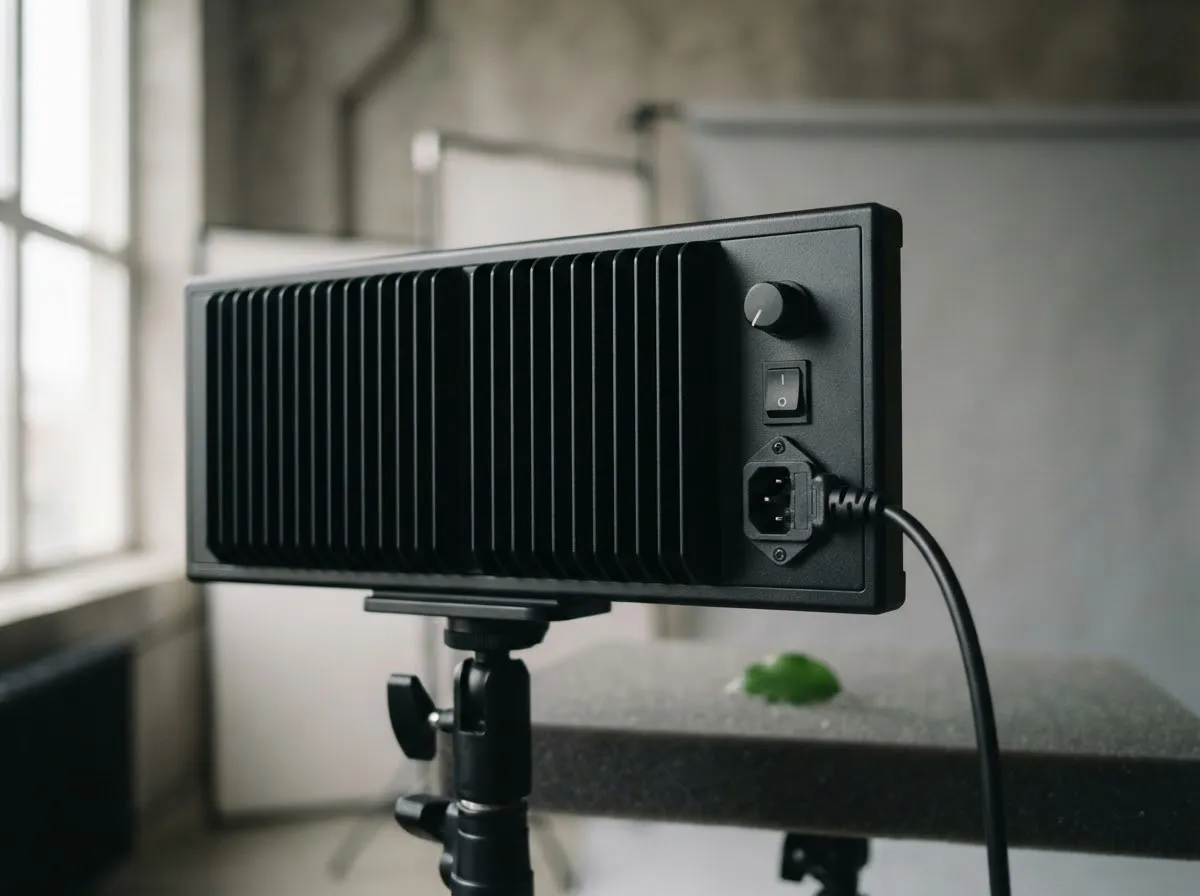
Small LED panels often run on camera batteries or USB-C power banks, making them portable for location shoots. Higher-output COB studio LEDs run on AC mains power or high-capacity V-mount/Gold-mount cinema batteries. For any mains-powered lighting gear, always follow the manufacturer’s operating manual, use rated stands and sandbags, and consult a licensed electrician for any mains wiring work.
If you shoot audio alongside video, check whether the fixture uses a cooling fan and whether it offers a silent or low-fan mode. High-wattage COB LEDs generate heat and rely on active fans; placing a noisy fan right next to a microphone will show up in your audio track.
Choosing Your First Continuous LED Setup
If you shoot mostly talking-head video, desk tutorials, or tabletop product photos in a small room, a single bi-color COB LED paired with a medium softbox—or a compact bi-color LED panel with a diffuser—gives you clean, controllable key light. Keep your ambient room lights off or matched in Kelvin so your subject’s skin stays free of mixed color casts, and start with the light close enough to keep ISO low and shadow edges soft. As you grow your kit, you can add a second smaller LED as a hair or background light without changing how you meter or compose.
For how we verify all technical specs and standards, read our review standards.
Frequently Asked Questions
Are continuous LED lights good for still photography?
Yes, continuous LED lights work well for portraits, product shots, and tabletop photography where subjects stay relatively still. Because the light stays on constantly, you see exact shadow placement and catchlights in real time, though continuous LEDs deliver far less peak output per dollar than flash units.
What is the difference between an LED panel and a COB LED light?
An LED panel spreads dozens or hundreds of small diodes across a flat rectangular board, producing a broad beam out of the box. A COB (Chip-on-Board) LED packs emitters into a single compact point source, allowing it to focus cleanly into Bowens-mount softboxes, Fresnel lenses, and umbrellas.
What CRI or TLCI score should you look for in a photo or video LED?
Look for CRI and TLCI ratings of 95 or higher for skin tones and color-critical work. As EBU Tech 3355 explains, TLCI evaluates a light’s spectrum through a camera’s color pipeline, whereas CRI measures color rendering for human vision—checking both helps prevent green or magenta skin casts.
Should beginners buy daylight-only or bi-color LED lights?
Choose a daylight-balanced (5600 K) LED if you want maximum brightness at a lower price and mostly shoot alongside window light. Choose a bi-color LED if you frequently shoot indoors under warm lamps and want to dial the fixture between tungsten (around 3200 K) and daylight without adding gels.
Why do continuous LEDs require higher ISO or slower shutter speeds than flash?
Continuous LEDs spread their electrical power steadily over every second, whereas strobes and speedlights dump stored capacitor energy in a fraction of a millisecond. That lower instantaneous brightness means you often open your aperture wider, raise ISO, or use slower shutter speeds compared with studio flash.
Sources
Common questions
Are continuous LED lights good for still photography?
Yes, continuous LED lights work well for portraits, product shots, and tabletop photography where subjects stay relatively still. Because the light stays on constantly, you see exact shadow placement and catchlights in real time, though continuous LEDs deliver far less peak output per dollar than flash units.
What is the difference between an LED panel and a COB LED light?
An LED panel spreads dozens or hundreds of small diodes across a flat rectangular board, producing a broad beam out of the box. A COB (Chip-on-Board) LED packs emitters into a single compact point source, allowing it to focus cleanly into Bowens-mount softboxes, Fresnel lenses, and umbrellas.
What CRI or TLCI score should you look for in a photo or video LED?
Look for CRI and TLCI ratings of 95 or higher for skin tones and color-critical work. As EBU Tech 3355 explains, TLCI evaluates a light's spectrum through a camera's color pipeline, whereas CRI measures color rendering for human vision—checking both helps prevent green or magenta skin casts.
Should beginners buy daylight-only or bi-color LED lights?
Choose a daylight-balanced (5600 K) LED if you want maximum brightness at a lower price and mostly shoot alongside window light. Choose a bi-color LED if you frequently shoot indoors under warm lamps and want to dial the fixture between tungsten (around 3200 K) and daylight without adding gels.
Why do continuous LEDs require higher ISO or slower shutter speeds than flash?
Continuous LEDs spread their electrical power steadily over every second, whereas strobes and speedlights dump stored capacitor energy in a fraction of a millisecond. That lower instantaneous brightness means you often open your aperture wider, raise ISO, or use slower shutter speeds compared with studio flash.
What we checked
- Aputure LS 600d Technical Specifications, checked 2026-11-14 (aputure.com)
- EBU Tech 3355: Television Lighting Consistency Index (TLCI-2012), checked 2026-11-14 (tech.ebu.ch)
- HyperPhysics: Inverse Square Law for Light, checked 2026-11-14 (hyperphysics.gsu.edu)
- Nikon Z fc Reference Manual: White Balance Presets, checked 2026-11-14 (onlinemanual.nikonimglib.com)
You might also like
- LED vs Strobe vs Speedlight: What to Start With
Compare continuous LED lights, camera speedlights, and studio strobes by output units, shutter sync, color control, and video use to pick your first light.
- Battery vs Mains-Powered Lights for Photo and Video
Compare battery and AC mains-powered photo and video lights on output limits, runtime, cable safety, portability, and fan noise before you buy.
- Bi-Color vs RGB LED Lights: What Each Does
Bi-color vs RGB LED lights compared on CCT range, white-light brightness, CRI/TLCI accuracy, green-magenta tint, and creative color modes.
- Budget Photo and Video Lighting Kit Guide
Build a budget photo and video lighting kit around one key light, a modifier, and a stand. Compare starter kit categories by output and control.
- Flash Guide Number Explained
How flash guide numbers work: the GN = distance x f-number formula, meters vs feet, zoom head effects, ISO scaling, and power steps.
- DIY Reflector and Diffuser from Household Materials
Make passive photo and video reflectors and diffusers from foam board, poster board, and sheer fabric without electrical DIY or fire hazards.