Lighting Gels: CTO and CTB for Color Matching
Author: Fiat Lux Guides Editorial Team Reviewer: Fiat Lux Guides Editorial Team Most recently reviewed First published Filed under Color and White Balance
CTO (Color Temperature Orange) and CTB (Color Temperature Blue) lighting gels shift a light source's Kelvin temperature so mixed lights match on camera. CTO warms daylight-balanced flash or LEDs down toward tungsten (around 3200K), while CTB cools warm tungsten lamps up toward daylight (around 5500K), at the cost of roughly 0.1 to 1.5 stops of light output depending on gel strength.
Belongs to the guide: Color Temperature and White Balance Explained
CTO and CTB lighting gels let you match two light sources of different colors before the light ever hits your camera sensor, solving one of the toughest problems in color temperature and white balance. When a daylight-balanced speedlight (around 5500K) fires in a room lit by warm tungsten lamps (around 2900K–3200K), no single camera white balance setting can make both look neutral—you fix the mismatch at the light source with a gel.
What CTO and CTB gels do
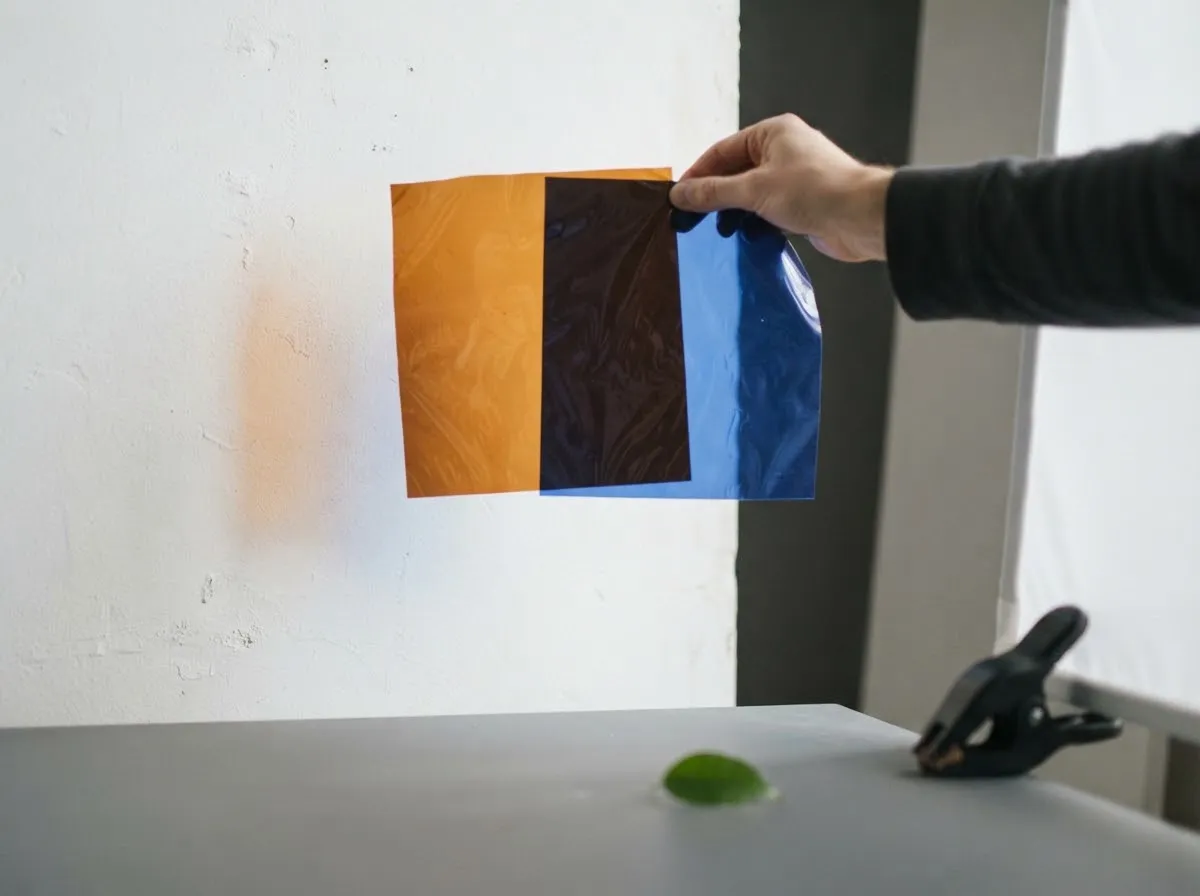
- CTO (Color Temperature Orange): An amber-orange filter placed over a daylight-balanced light (strobe, speedlight, daylight LED, or even a window) to warm it down toward tungsten.
- CTB (Color Temperature Blue): A blue filter placed over a warm tungsten or halogen lamp to cool it up toward daylight.
If you have ever wondered why indoor photos show orange backgrounds and blue-tinted flash subjects, read our guide on mixed lighting and color casts. For the underlying Kelvin scale, see what is color temperature and white balance settings.
Mired shift math: how to pick the right strength
Gels are engineered around mireds (micro reciprocal degrees), defined as:
Mired = 1,000,000 / Kelvin
Unlike Kelvin, mired shifts are additive: Mired_target - Mired_source = Mired_shift. You can compute this instantly in our Kelvin color temperature chart and light matcher.
From Rosco’s Cinegel specification tables, here is how common strengths behave:
- Full CTO (Rosco 3407, +167 mired): Converts 6500K daylight to 3200K tungsten (or 5500K to 2900K).
- Three-Quarter CTO (Rosco 3411, +131 mired): Converts 5500K daylight to 3200K tungsten.
- Half CTO (Rosco 3408, +81 mired): Converts 5500K daylight to 3800K.
- Quarter CTO (Rosco 3409, +42 mired): Converts 5500K daylight to 4500K.
- Full Blue CTB (Rosco 3202, -131 mired): Converts 3200K tungsten to 5500K daylight.
- Half Blue CTB (Rosco 3204, -68 mired): Converts 3200K tungsten to 4100K.
Accounting for light loss (transmission)
Every gel absorbs light, and blue gels absorb more than orange gels:
- Full CTO (3407) transmits 47% of light (-1.1 stops).
- Full Blue CTB (3202) transmits 36% of light (-1.5 stops).
- Quarter CTO (3409) transmits 81% of light (-0.3 stops).
Because Full CTB costs 1.5 stops (Rosco’s table), it is almost always better to gel a daylight flash or LED with CTO (when matching tungsten) or set the camera to tungsten/custom white balance and gel only the minority light source.
When CTO/CTB is not enough: green and magenta tint
CTO and CTB only move color along the warm-to-cool (amber-to-blue) axis. If an indoor fluorescent tube or low-CRI LED has a green spike, CTO/CTB will not remove it—you need a Minus Green (magenta) or Plus Green gel, or digital tint adjustment, as explained in our Kelvin vs tint (green-magenta) guide.
Practical handling and safety
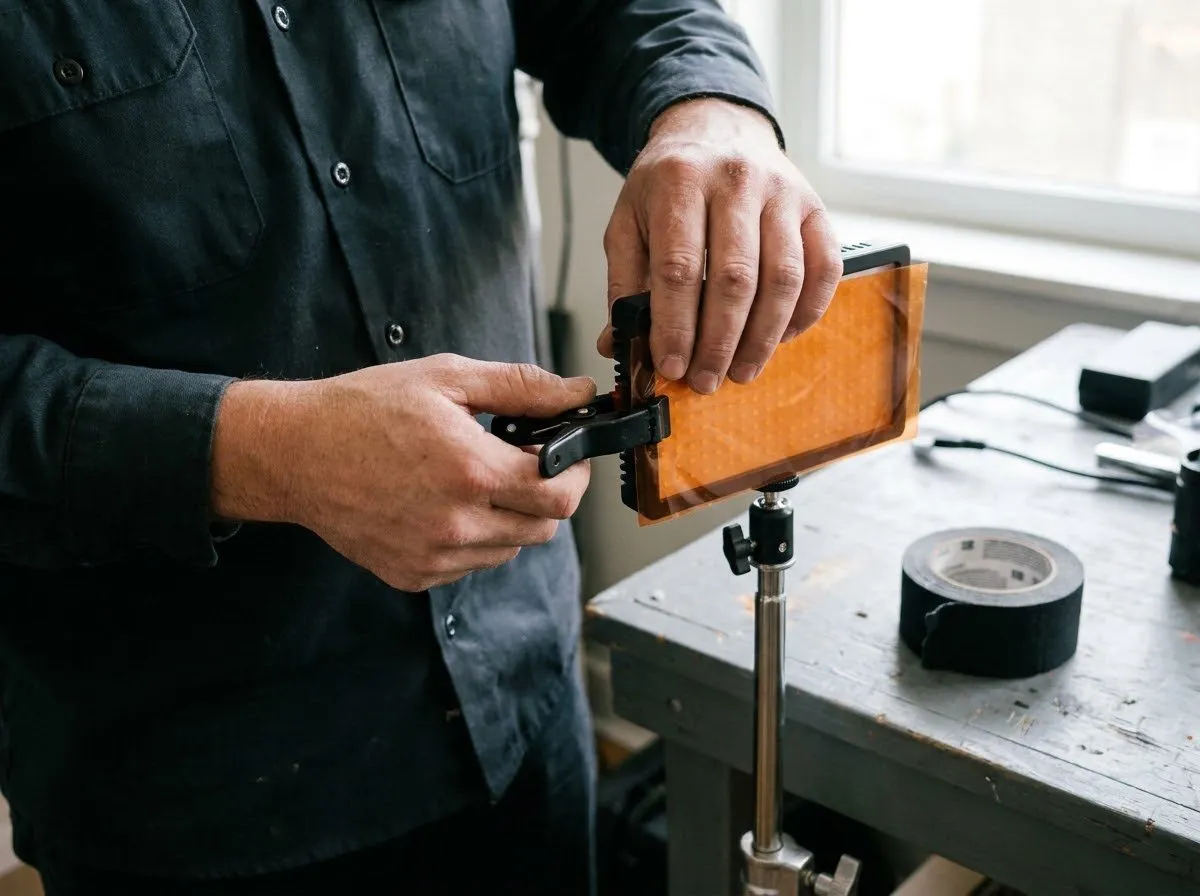
- Keep air gaps on hot lights: Never tape polyester gels directly onto hot tungsten or halogen bulbs or tight quartz housings—follow the fixture maker’s manual for gel frames, clip distances, and heat ratings.
- Check white balance after gelling: Take a custom white balance reading or test frame once the gel is mounted so your camera’s Kelvin setting matches the newly balanced scene.
For how Fiat Lux Guides verifies manufacturer gel data, see our review standards.
| Gel | Typical conversion | Mired shift | Transmission (stop loss) |
|---|---|---|---|
| Full CTO (3407) | 6500K daylight to 3200K tungsten | +167 | 47% (-1.1 stops) |
| Half CTO (3408) | 5500K daylight to 3800K | +81 | 73% (-0.5 stops) |
| Quarter CTO (3409) | 5500K daylight to 4500K | +42 | 81% (-0.3 stops) |
| Eighth CTO (3410) | 5500K daylight to 4900K | +20 | 92% (-0.1 stops) |
| Full Blue CTB (3202) | 3200K tungsten to 5500K daylight | -131 | 36% (-1.5 stops) |
| Half Blue CTB (3204) | 3200K tungsten to 4100K | -68 | 52% (-0.9 stops) |
| Quarter Blue CTB (3208) | 3200K tungsten to 3500K | -30 | 74% (-0.4 stops) |
Common questions
What do CTO and CTB stand for in lighting gels?
CTO stands for Color Temperature Orange, which warms a cool daylight-balanced source (around 5500K–6500K) down toward tungsten (around 3200K). CTB stands for Color Temperature Blue, which cools a warm tungsten source (around 3200K) up toward daylight (around 5500K) for matching mixed light sources.
Why are lighting gels rated in mireds instead of just Kelvin?
A gel shifts color temperature by a fixed number of mireds (micro reciprocal degrees, equal to 1,000,000 / Kelvin), not a fixed number of Kelvin. For example, a +131 mired shift drops 5500K to 3200K (a 2300K change), while the same gel on a 3200K lamp shifts it to ~2255K (a 945K change). Mired math stays additive across any starting Kelvin.
How much light do you lose with Full CTO vs Full CTB?
Per Rosco Cinegel specifications, Full CTO (3407) transmits 47% of light—roughly 1.1 stops of loss—while Full Blue CTB (3202) transmits only 36% of light, costing 1.5 stops. Whenever possible, it is more light-efficient to gel a daylight source orange than to gel a tungsten source blue.
When should I use Half or Quarter CTO instead of Full CTO?
Use Half or Quarter CTO when you want a gentle warm skin tone or need to match a daylight flash to warm indoor lamps (around 3800K–4500K) without going all the way to 3200K. Quarter CTO also warms cool open-shade flash or LEDs slightly while losing only 0.3 stops.
Can CTO or CTB gels fix a green tint from fluorescent or cheap LED lights?
No. CTO and CTB shift color along the blue-amber (Kelvin) axis only. To remove a green cast or match a greenish fluorescent tube, you need a Minus Green (magenta) gel or a Plus Green gel, which shifts the green-magenta (tint/Duv) axis.
What we checked
You might also like
- Color Temperature and White Balance Explained
Learn Kelvin color temperature, camera white balance presets, green/magenta tint, CRI vs TLCI, and how to prevent mixed-lighting color casts.
- CRI and TLCI Explained: Color Accuracy of Lights
Understand what CRI and TLCI measure, why CRI can miss red skin tones on LEDs, and what TLCI scores mean for photo and video.
- Custom White Balance with a Gray Card
How to set custom white balance in-camera with a gray or white card for accurate skin tones under LEDs, window light, and mixed lighting.
- Kelvin vs Tint: Fixing Green and Magenta Color Casts
Learn the difference between Kelvin color temperature and green-magenta tint (Duv), why LEDs shift green, and how to fix color casts.
- Matching LED Lights to Daylight
How to match LED video and photo lights to window daylight using Kelvin presets, mired shifts, and camera white balance without mixed color casts.
- Mixed Lighting and Color Casts: Why Skin Looks Orange or Blue
Fix orange and blue color casts caused by mixing window light, household lamps, and LEDs. Learn how to match light color temperatures on set.