Hard Light vs Soft Light: What Changes the Shadows
Author: Fiat Lux Guides Editorial Team Reviewer: Fiat Lux Guides Editorial Team Most recently reviewed First published Filed under Setups and Exposure
Hard light comes from a source with a small apparent angular size relative to the subject, casting sharp-edged shadows with minimal transition. Soft light comes from a source with a large apparent angular size—such as a close softbox, overcast sky, or shaded window—which widens the partial-shadow penumbra and produces gradual, smooth shadow transitions.
Belongs to the guide: Three-Point Lighting Explained for Beginners
In the classic three-light arrangement and studio work, the difference between hard light and soft light comes down to one geometric factor: the apparent angular size of the light source as seen from your subject. Hard light comes from a source with a small apparent size (like bare direct sun or an unmodified flash), producing crisp shadow edges, while soft light comes from a source with a large apparent size (like a close softbox or an overcast sky), producing gradual shadow transitions.
Brightness, wattage, and color temperature do not make a light hard or soft. A dim bare LED can still cast razor-sharp shadows, and a powerful studio strobe inside a large modifier close to a portrait subject produces smooth, wrapping light.
The geometry behind shadow edges: umbra and penumbra
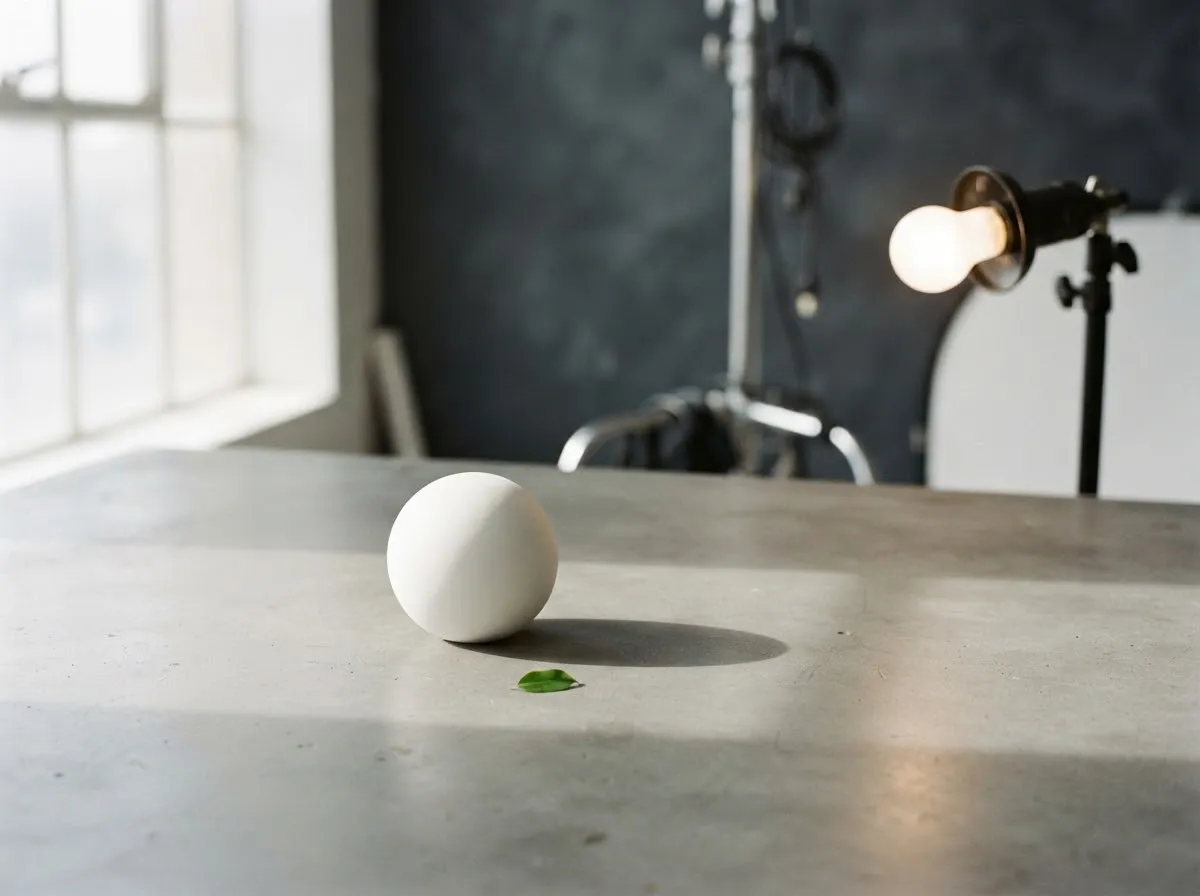
Every shadow cast by a real, physical light source has two zones, as illustrated in OpenStax’s shadow geometry overview:
- Umbra: The darkest central core of the shadow where the blocking object hides the entire light source.
- Penumbra: The lighter, partial-shadow border where part of the extended light source is blocked and part still reaches the surface.
When a light source is small in angular width, rays arrive from nearly one direction, leaving almost no penumbra—so the shadow snaps cleanly from lit to dark. When a light source is large in angular width, rays arrive from many angles at once, widening the penumbra into a smooth gradient.
The apparent angular width ($\theta$) of a flat source of width $w$ at distance $d$ is:
$$\theta = 2 \cdot \arctan\left(\frac{w}{2d}\right)$$
And by similar triangles, the penumbra width ($p$) on a background at distance $d_o$ behind the blocking edge is proportional to source size $s$ and inversely proportional to source distance $d$:
$$p = s \cdot \frac{d_o}{d}$$
Both equations explain why increasing modifier size ($w$ or $s$) or decreasing distance ($d$) softens shadow edges, while moving the background farther away ($d_o$) also blurs cast shadows.
Why bare sunlight is hard and overcast skies are soft
Outdoor light shows this geometry at its extremes. Even though the Sun has a mean radius of 695,700 km, NASA’s Sun Fact Sheet lists its apparent angular diameter from Earth at 1 A.U. as 1,919 seconds of arc—just 0.53 degrees. Because 0.53 degrees is nearly a point source, direct midday sun casts crisp, high-contrast shadows.
When clouds roll in, the entire sky dome scatters sunlight across a 180-degree hemisphere. Every point on the subject receives light from a huge range of angles, which widens the penumbra until shadow edges nearly disappear. See open shade and overcast light for how to use this outdoors.
How modifiers and distance work together
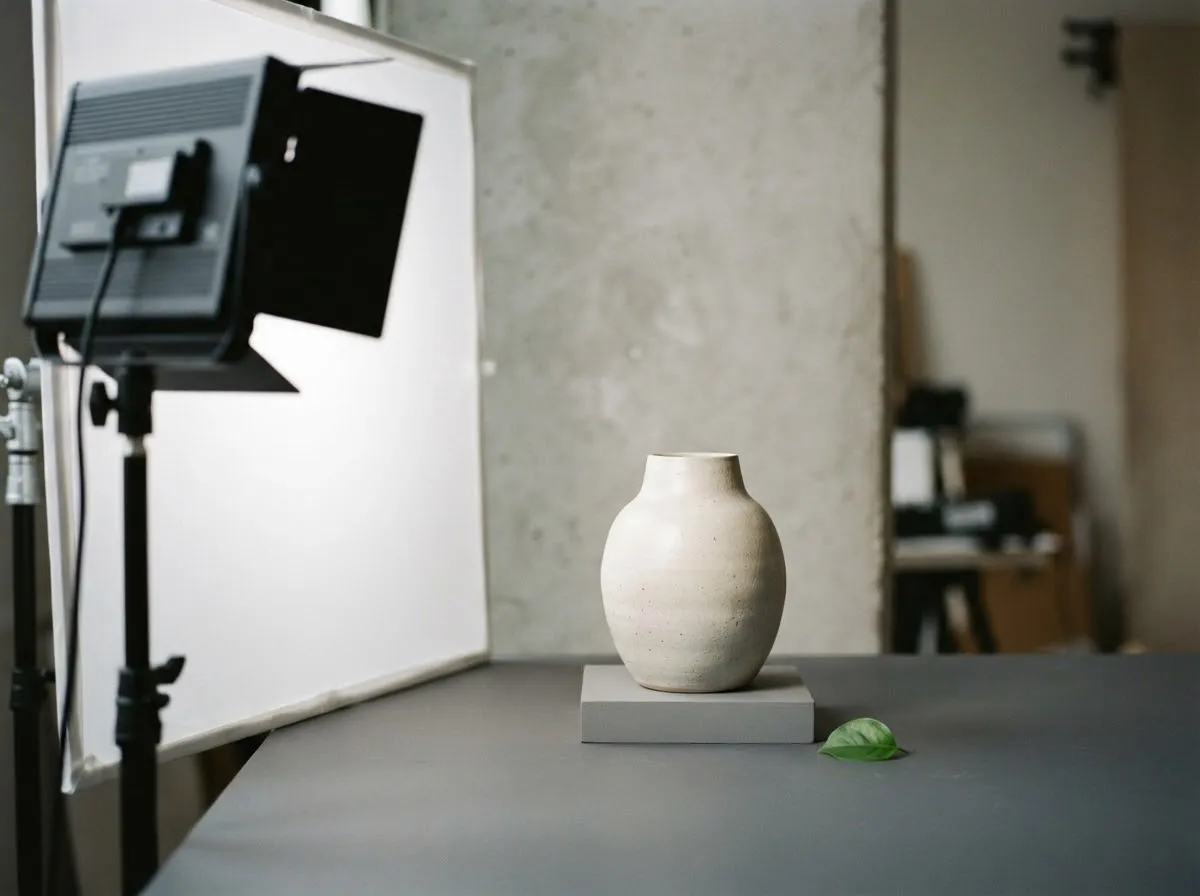
Lighting modifiers such as softboxes and umbrellas exist to enlarge the emitting surface of a small bulb or flash tube. As noted in Profoto’s softbox documentation, Profoto’s softbox range comes in rectangular, octa, and strip shapes with a removable diffuser; the size of that front surface sets how soft the light looks.
However, modifier size only tells half the story—distance matters just as much:
- Large modifier, close distance: A 90 cm softbox placed 1 meter from a subject spans roughly 48 degrees of angular width, wrapping light smoothly around facial contours.
- Large modifier, far distance: Move that same 90 cm softbox back to 6 meters, and its angular width shrinks to about 8.6 degrees—casting noticeably firmer, more defined shadows.
To see how a given modifier width and distance translate into an angular size, enter them in the softbox softness calculator.
Distance also changes brightness falloff under the inverse square law, which you can check alongside exposure changes in our light distance exposure calculator. For a breakdown of softboxes, umbrellas, and reflectors, see light modifiers explained.
Which should you choose for your shot?
Neither hard light nor soft light is universally “better”; each serves a clear visual purpose:
- Use soft light for portraits, interviews, and video calls where you want smooth skin transitions, forgiving shadow edges, and fewer distracting wall shadows.
- Use hard light when you want crisp graphic shadows, pronounced surface texture on fabric or food, or efficient reach across a larger room without bulky modifiers.
Be careful not to confuse softness (shadow-edge transition) with contrast (the brightness difference between lit and shadow sides). Even a very soft light can look high-contrast if there is no fill light on the shadow side—a common trap covered in common lighting mistakes. Our sourcing and review approach describes how we verify optics and manufacturer references across our guides.
| Attribute | Hard Light | Soft Light |
|---|---|---|
| Apparent source size | Small angular size relative to subject | Large angular size relative to subject |
| Shadow edge (penumbra) | Narrow, crisp transition from light to dark | Wide, gradual gradient across the edge |
| Typical sources | Bare flash, bare LED, hard reflector, direct sun | Softbox, shoot-through umbrella, shaded window, overcast sky |
| Surface texture | Accentuates pores, wrinkles, and fine detail | Smooths small surface texture and transitions |
| Spill and control | Tighter beam; easier to flag or shape | Broad wrap; spills easily onto nearby walls |
Choose soft light when you want forgiving skin tones and gradual shadow transitions on faces or video calls; choose hard light when you need crisp shadow shapes, punchy contrast, or maximum light reach from a small fixture.
Common questions
What actually makes a light source soft or hard?
Light softness depends on the apparent angular size of the light source as seen from the subject—not on wattage, brightness, or whether the light is LED or flash. A large source close to the subject covers a wide angle, creating a broad penumbra and soft shadow edges, whereas a small or distant source covers a narrow angle and casts sharp shadows.
Why does moving a softbox closer make the light softer?
Moving a softbox closer increases its angular width from the subject's point of view, following the geometry theta = 2 * atan(w / (2 * d)). Because light rays arrive from a wider range of angles around the subject, the partial-shadow penumbra widens and shadow edges become noticeably smoother.
Why is direct midday sunlight considered hard light even though the Sun is huge?
Although the Sun is enormous in physical diameter, it sits roughly 149.6 million kilometers away, giving it an apparent angular diameter of only about 0.53 degrees from Earth. Because it occupies such a tiny angle in the sky, shadows cast by bare direct sunlight have a sharp umbra and almost no penumbra.
Does a diffuser or softbox change light quality if you place it very far away?
No, moving a softbox far enough away shrinks its apparent angular size until it behaves much like a hard light again. A 1-meter softbox placed 10 meters away occupies roughly the same narrow angle as a small bare bulb placed close up, so distance and modifier size always work together.
Can you get soft light without buying a large softbox?
Yes, you can bounce a bare flash or continuous LED off a large matte white wall, ceiling, or foam board, or shine it through a sheer curtain or diffusion panel. Any large neutral surface that scatters the beam becomes your new, larger effective light source.
What we checked
- OpenStax Astronomy 2e: 4.7 Eclipses of the Sun and Moon (Umbra and Penumbra), checked 2026-11-14 (openstax.org)
- NASA Sun Fact Sheet (Apparent Diameter from Earth), checked 2026-11-14 (nssdc.gsfc.nasa.gov)
- Profoto: Softboxes Product Overview, checked 2026-11-14 (profoto.com)
- HyperPhysics: Inverse Square Law for Light, checked 2026-11-14 (hyperphysics.gsu.edu)
You might also like
- Three-Point Lighting Explained for Beginners
Learn three-point lighting—key light, fill light, and backlight—plus how source size controls shadow softness and how distance and stops control exposure.
- Common Lighting Mistakes in Photo and Video
Spot and fix the most common photo and video lighting mistakes: mixed color casts, flat on-axis light, harsh overhead shadows, and distance falloff.
- Exposure Basics for Lighting: Stops, ISO, Aperture, Power
Understand how stops of light connect aperture, shutter speed, ISO, and flash or LED power so you can adjust lighting exposure accurately.
- Headshot Lighting at Home
Set up clean headshot lighting at home with a window or a single LED or strobe, covering light angle, background separation, and shadow fill.
- The Inverse Square Law of Light for Photographers
Learn how the inverse square law controls light falloff, exposure stops, and background separation in photography and video.
- Key-to-Fill Ratio Explained
Learn what key-to-fill lighting ratios mean in f-stops, how 2:1, 4:1, and 8:1 contrast looks on camera, and how to measure ratios with a light meter.