Golden Hour Photography Explained
Author: Fiat Lux Guides Editorial Team Reviewer: Fiat Lux Guides Editorial Team Most recently reviewed First published Filed under Natural Light
Golden hour has no single official astronomical definition, though a widely used software convention treats it as the period when the Sun is between the horizon and about 6 degrees above it. During this low-angle window, sunlight travels through a thicker path of Earth's atmosphere, scattering away blue wavelengths and leaving warm, directional, lower-contrast light for portraits and landscapes.
Belongs to the guide: Natural Light Photography: A Beginner Guide
Checked by Fiat Lux Guides’ editorial desk against the cited sources.
Golden hour is one of the most reliable lighting conditions in natural light photography. Although there is no official astronomical definition of golden hour, photographers and solar-tracking tools commonly treat it as the window when the Sun sits between the horizon and about +6° of elevation—the cutoff used for golden hour in the SunCalc solar library source code ([6, 'goldenHourEnd', 'goldenHour']). Understanding the physics behind that low solar angle helps you predict when the light will peak, choose the best subject direction, and keep your camera settings from fighting the warmth.
Why Does Golden Hour Light Look Warm and Soft?
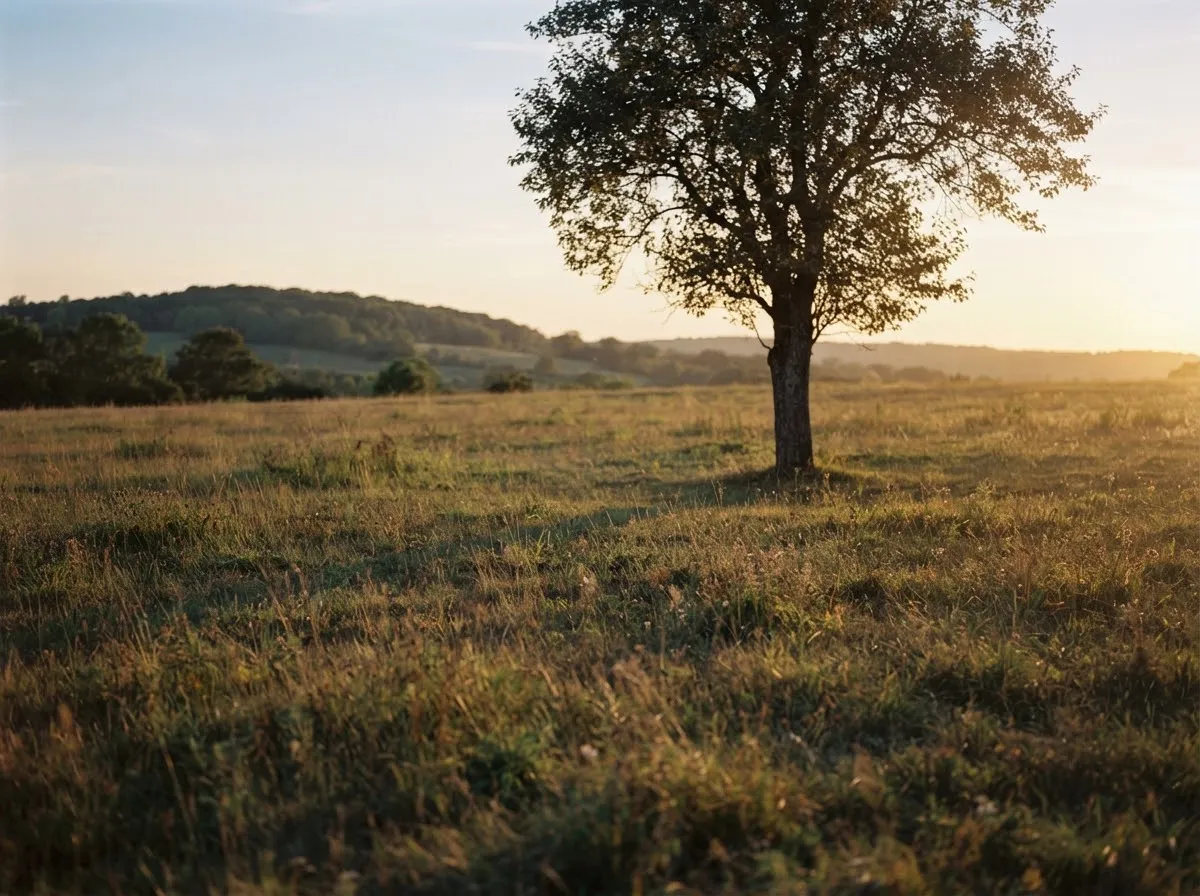
Two physical effects transform sunlight when the Sun drops close to the horizon: Rayleigh scattering and low-angle geometry.
- Longer atmospheric path (Rayleigh scattering): Sunlight contains the full visible spectrum, from short-wavelength blue and violet light to long-wavelength red and orange light. As NASA Earth Observatory explains, the atmosphere scatters more of the shorter blue wavelengths of sunlight than the longer orange and red wavelengths. At midday, sunlight takes a relatively short path straight down through the atmosphere. Near sunrise or sunset, the beam skims obliquely through a much thicker layer of air, scattering away most of the blue light before it reaches your subject. What remains in the direct beam is rich in yellow, orange, and red wavelengths.
- Reduced intensity and lower contrast: Because atmospheric scattering and absorption attenuate the direct solar beam, the brightness gap between sunlit highlights and sky-lit shadows narrows compared with harsh midday sun.
- Horizontal directionality: Instead of shining down from overhead—which casts deep shadows under eyebrows, noses, and chins—golden hour sunlight travels nearly parallel to the ground, illuminating faces evenly and skimming across textures in landscapes.
When Does Golden Hour Happen and How Long Does It Last?
Because the Sun moves along an arc tilted by your latitude and the Earth’s seasonal axial tilt, golden hour is rarely an exact 60-minute clock block.
- Sunrise and sunset definition: According to the U.S. Naval Observatory, sunrise or sunset is defined to occur when the geometric zenith distance of the Sun’s center is 90.8333° (about 0.833° below the geometric horizon). NOAA’s solar calculator likewise assumes 0.833° of atmospheric refraction for sunrise and sunset.
- Civil twilight boundary: The U.S. Naval Observatory defines civil twilight as the period when the center of the Sun is between the horizon and 6° below the horizon (−6°). Civil twilight lies just below that low-sun period, once the Sun has set.
- Latitude and season effects: Near the equator, the Sun rises and sets almost vertically, so it passes through the low-elevation band relatively quickly. At high latitudes, the Sun grazes the horizon at a shallow angle, so the low-sun period stretches much longer—and in winter the Sun may never climb above +6° at all.
For planning local sunrise, sunset, and twilight windows, enter your latitude, longitude and date in the sun-position times tool, which uses the NOAA solar position method and shows sunrise, sunset and the low-sun windows for your location, or compare golden hour with open shade and overcast light when clouds cover the horizon.
Morning vs. Evening Golden Hour: How They Differ
Both morning and evening golden hours share identical solar geometry, yet atmospheric and practical conditions often make them look distinct:
- Morning golden hour: Mist or dew can catch the low rays, and the light changes quickly as the Sun climbs, so plan your most delicate frames for the first minutes and move to backlit or side-lit frames as the Sun rises.
- Evening golden hour: Shadows lengthen rapidly at the end of the session, transitioning into twilight right after sunset.
How to Position Your Subject in Golden Hour Light

Where you place your subject relative to the low Sun changes the mood dramatically:
- Front lighting (Sun behind the camera): The Sun shines directly onto the subject’s face or landscape, saturating colors and illuminating details cleanly. Watch your own shadow so it does not fall into the bottom of the frame, and ask portrait subjects to look slightly off-axis if the low Sun causes squinting.
- Side lighting (Sun at roughly 90° to the lens): Low side light sculpts facial contours and stretches long, soft-toned shadows across walls, grass, or rock faces. This angle reveals texture without the harsh contrast of overhead noon light.
- Backlighting (Sun behind the subject): Placing the Sun just behind your subject’s shoulder creates a glowing rim of warm light around hair, clothing, and foliage. Because the bright sky behind the subject can fool your camera’s meter into underexposing the face, dial in positive exposure compensation (+1 to +2 EV) or bounce warm light back onto the front of the subject with a white reflector. If you are shooting indoors near a west- or east-facing window during this hour, see our window light portrait setup guide.
Best Camera and White Balance Settings for Golden Hour
Golden hour light shifts brightness and color minute by minute, so locking a few key settings prevents your camera from undoing the scene’s natural warmth.
- Turn off Auto White Balance (AWB): Most cameras’ Auto White Balance algorithms try to neutralize strong color casts. If AWB detects warm amber sunlight, it may add blue to make whites look neutral—erasing the golden glow. Instead, lock your white balance to Direct sunlight (listed as approximately 5200 K in Nikon’s white balance reference) to record the scene’s true warmth, or choose Cloudy (approximately 6000 K) for an even warmer look. To see how Kelvin values shift color, explore our Kelvin color temperature chart.
- Shoot RAW when possible: Recording RAW files preserves full sensor data so you can fine-tune Kelvin temperature and highlight recovery later without degrading tonal transitions.
- Watch highlight clipping: Direct low Sun in the frame or specular reflections on water can clip highlights quickly. Monitor your histogram or blinkies, and expose to protect highlight detail on bright skin or clouds while keeping shadows clean.
- Stabilize as light drops: As the Sun dips below the horizon into civil twilight, ambient light levels fall fast. Open your aperture, raise ISO, or mount the camera on a tripod before shutter speeds drop low enough to introduce motion blur.
What to Do When Clouds Block the Sun at Golden Hour
A completely overcast sky diffuses the Sun’s directional beam, eliminating the warm rim light and long shadows associated with golden hour. However, partial clouds—especially high clouds with a clear gap near the horizon—often create the most dramatic golden hour skies because low red and orange rays illuminate the undersides of the clouds above. If thick clouds seal the horizon completely, switch to open shade and overcast light techniques, using the giant overhead softbox of the clouds for even, shadowless portraits.
For how we verify all astronomical and manufacturer data, see our verification process.
Frequently Asked Questions
What is golden hour in photography?
Golden hour is the period shortly after sunrise and shortly before sunset when the Sun sits low near the horizon. While no official astronomical body defines it, the SunCalc solar library’s convention treats golden hour as ending in the morning (and starting in the evening) at 6 degrees of solar elevation, producing warm, directional, lower-contrast light.
Why is golden hour light warmer and softer than midday sun?
Low-angle sunlight travels through a much longer path of Earth’s atmosphere than overhead midday sun. According to NASA’s Earth Observatory, the atmosphere scatters more of the shorter blue wavelengths than the longer orange and red wavelengths, so a longer path leaves warmer light in the direct beam.
Does golden hour always last exactly one hour?
No. Despite the name, golden hour duration varies by latitude and season because the Sun’s path crosses the horizon at different angles. Where the Sun rises and sets steeply, as near the equator, it climbs through the low-elevation band quickly, whereas at high latitudes the Sun moves along the horizon at a shallow angle and the warm low-sun light lasts much longer.
What white balance setting should you use during golden hour?
Use a fixed Direct sunlight preset (roughly 5200 K on Nikon cameras) or Cloudy preset (roughly 6000 K) rather than Auto White Balance. Auto White Balance often tries to neutralize the warm amber cast by cooling the image down, stripping away the golden color you came to photograph.
What is the difference between golden hour and blue hour?
Golden hour occurs while the Sun is low, between the horizon and roughly 6 degrees above it, delivering warm directional light. Blue hour happens when the Sun is below the horizon; SunCalc describes it as roughly -4 to -8 degrees, while USNO defines civil twilight as the Sun’s center being up to 6 degrees below the horizon. The sky is lit by cool ambient light with no direct sun.
Sources
- NOAA Global Monitoring Laboratory: Solar Calculation Details, checked 2026-11-14
- NOAA Global Monitoring Laboratory: General Solar Position Equations (PDF), checked 2026-11-14
- U.S. Naval Observatory: Rise, Set, and Twilight Definitions, checked 2026-11-14
- NASA Science Earth Observatory: Crepuscular Rays and Light Scattering, checked 2026-11-14
- SunCalc Solar Position Library Documentation, checked 2026-11-14
- Nikon Z fc Reference Manual: White Balance Presets, checked 2026-11-14
Common questions
What is golden hour in photography?
Golden hour is the period shortly after sunrise and shortly before sunset when the Sun sits low near the horizon. While no official astronomical body defines it, the SunCalc solar library's convention treats golden hour as ending in the morning (and starting in the evening) at 6 degrees of solar elevation, producing warm, directional, lower-contrast light.
Why is golden hour light warmer and softer than midday sun?
Low-angle sunlight travels through a much longer path of Earth's atmosphere than overhead midday sun. According to NASA's Earth Observatory, the atmosphere scatters more of the shorter blue wavelengths than the longer orange and red wavelengths, so a longer path leaves warmer light in the direct beam.
Does golden hour always last exactly one hour?
No. Despite the name, golden hour duration varies by latitude and season because the Sun's path crosses the horizon at different angles. Where the Sun rises and sets steeply, as near the equator, it climbs through the low-elevation band quickly, whereas at high latitudes the Sun moves along the horizon at a shallow angle and the warm low-sun light lasts much longer.
What white balance setting should you use during golden hour?
Use a fixed Direct sunlight preset (roughly 5200 K on Nikon cameras) or Cloudy preset (roughly 6000 K) rather than Auto White Balance. Auto White Balance often tries to neutralize the warm amber cast by cooling the image down, stripping away the golden color you came to photograph.
What is the difference between golden hour and blue hour?
Golden hour occurs while the Sun is low, between the horizon and roughly 6 degrees above it, delivering warm directional light. Blue hour happens when the Sun is below the horizon; SunCalc describes it as roughly -4 to -8 degrees, while USNO defines civil twilight as the Sun's center being up to 6 degrees below the horizon. The sky is lit by cool ambient light with no direct sun.
What we checked
- NOAA Global Monitoring Laboratory: Solar Calculation Details, checked 2026-11-14 (gml.noaa.gov)
- NOAA Global Monitoring Laboratory: General Solar Position Equations (PDF), checked 2026-11-14 (gml.noaa.gov)
- U.S. Naval Observatory: Rise, Set, and Twilight Definitions, checked 2026-11-14 (aa.usno.navy.mil)
- NASA Science Earth Observatory: Crepuscular Rays and Light Scattering, checked 2026-11-14 (science.nasa.gov)
- SunCalc Solar Position Library Documentation and Source, checked 2026-11-14 (github.com)
- Nikon Z fc Reference Manual: White Balance Presets, checked 2026-11-14 (onlinemanual.nikonimglib.com)
You might also like
- Natural Light Photography: A Beginner Guide
Learn natural light photography: how sun angle, window size, open shade, and overcast skies shape shadow softness, color temperature, and exposure.
- Backlight and Rim Light with a Window
How to shoot backlit window portraits and rim light using metering, exposure lock, flare control, and reflector fill without blowing out skin tones.
- Food Photography with Window Light
Use side light, backlight, sheer diffusion, and bounce cards to shape texture and highlights in food photography with window light.
- Indoor Natural Light Photography Without Flash
How to shoot indoor natural light photography without flash using window placement, camera exposure settings, white balance, and falloff control.
- Natural Light vs Artificial Light: When to Use Each
Natural light vs artificial light compared on cost, color stability, power, and control so you can decide when window light or studio gear fits best.
- Open Shade and Overcast Light for Photos
How to find open shade, use overcast clouds as a giant softbox, fix blue color casts with white balance, and keep catchlights in outdoor portraits.