Battery vs Mains-Powered Lights for Photo and Video
Author: Fiat Lux Guides Editorial Team Reviewer: Fiat Lux Guides Editorial Team Most recently reviewed First published Filed under Lighting Gear
Choose mains-powered lights for unlimited runtime, full-wattage output, and lower upfront cost at a fixed desk or studio, and choose battery-powered lights when you shoot on location without wall outlets or need cable-free stands. Many mid-size LEDs accept both AC adapters and NP-F or V-mount batteries, though battery voltage limits can cap maximum brightness.
Belongs to the guide: LED vs Strobe vs Speedlight: What to Start With
Every photo and video light falls into one of three power designs: battery-only, mains-only (AC wall power), or hybrid fixtures that accept both. In our pillar guide on LED vs. strobe vs. speedlight, power source is one of the main practical dividers between portable speedlights, compact LEDs, and studio fixtures.
How battery-powered lights work in practice
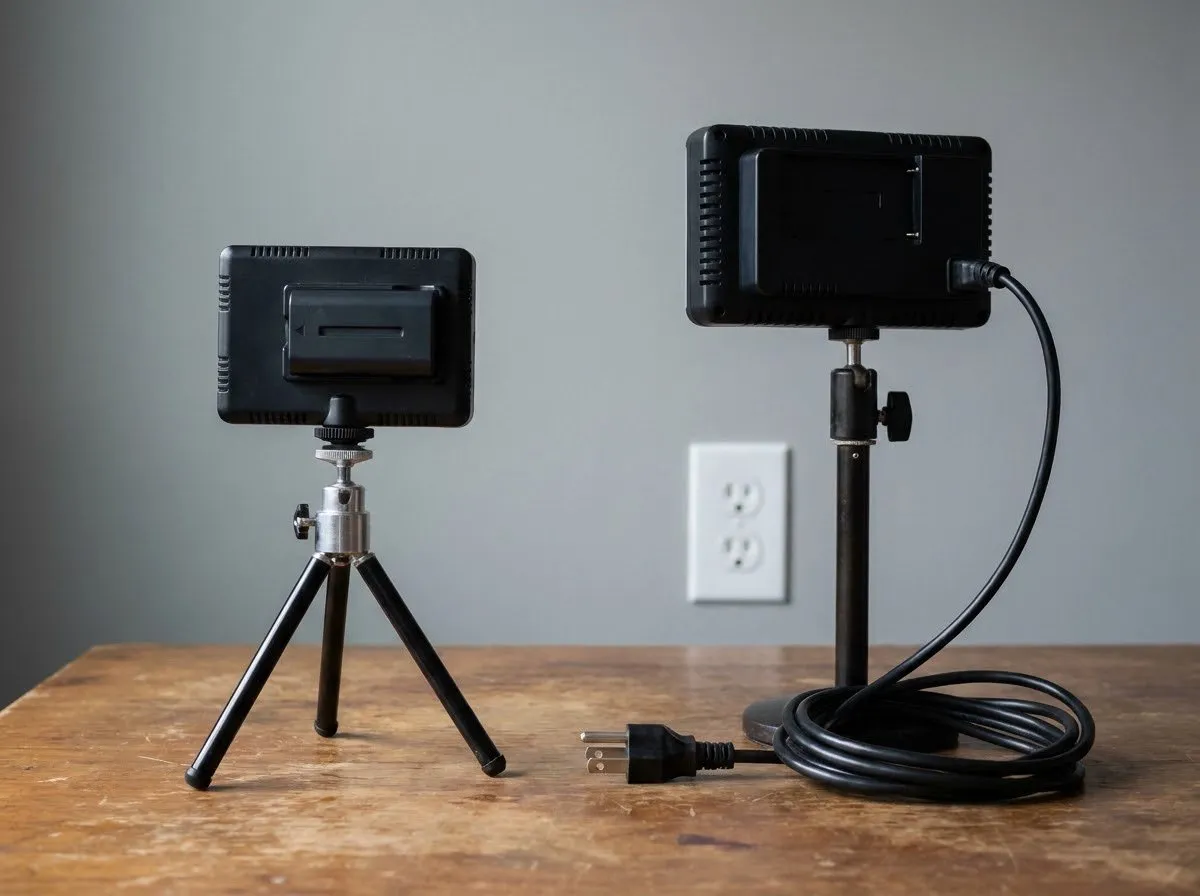
Battery-powered lights—from AA-powered speedlights to NP-F panels and V-mount COB fixtures—trade unlimited runtime for freedom from wall outlets.
- Speedlights and battery strobes store energy in internal capacitors and fire short bursts, allowing hundreds of flashes from a compact pack. See speedlight vs. studio strobe for how recycle times compare.
- Continuous LED lights draw steady wattage the entire time they are switched on. For example, Aputure’s documentation for the LS 60x lists a 90W maximum power draw and says a D-Tap battery must support 90W output to be compatible; it also estimates that two NP-F970 batteries could run the light at full power for roughly one hour.
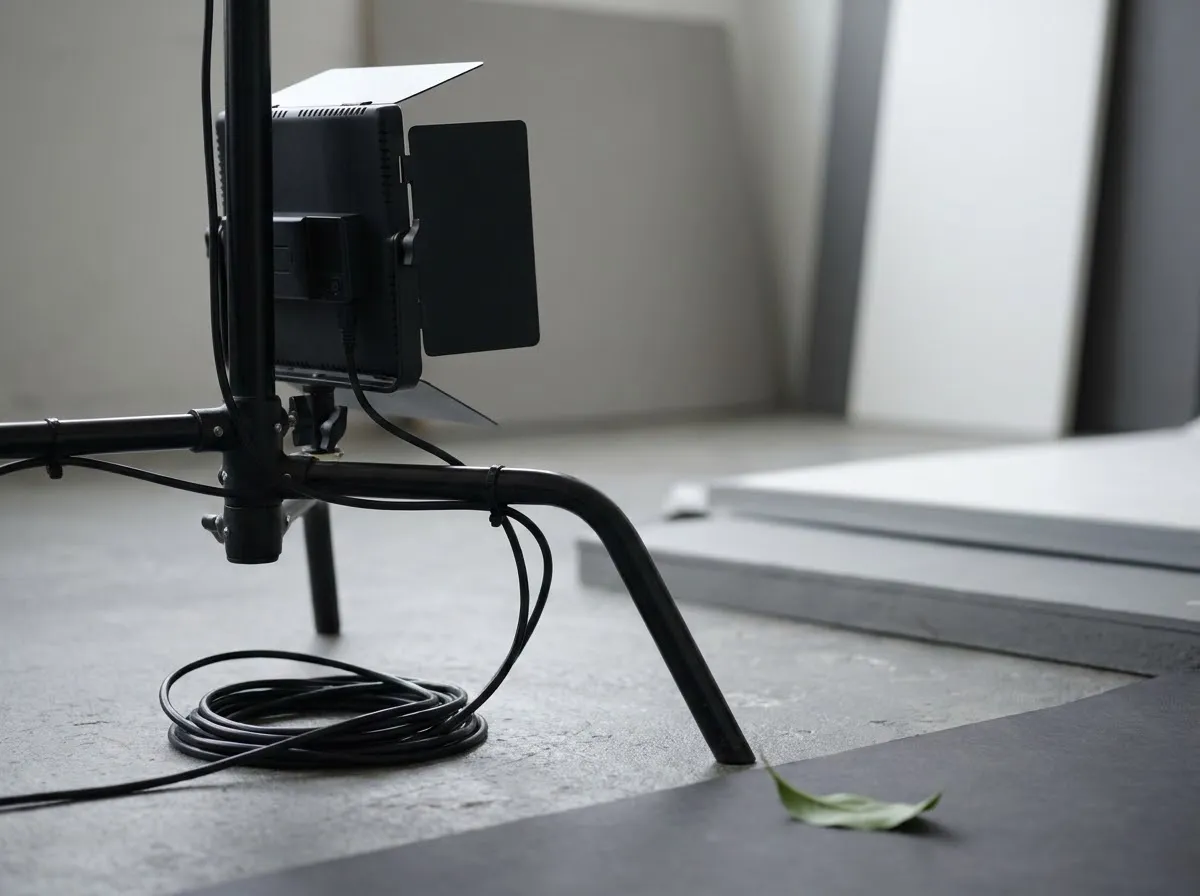
- Weight and balance: Mounting heavy batteries on a light stand can make it top-heavy or stabilize the base depending on where the battery plate sits.
How mains-powered (AC) lights work in practice
Mains-powered fixtures plug into a standard wall outlet through an integrated power supply or an external AC-to-DC brick.
- Consistent full power: On wall power the fixture is not limited by battery capacity or discharge rating, so it can run at its full rated output for as long as you need.
- Lower starter cost: You do not need to buy spare batteries, dual chargers, or V-mount plates just to get through a long recording.
- Cable management: Power cords must be routed safely around stands. Aputure’s safety manuals specify positioning cables where they cannot be tripped over or touch hot surfaces, and using extension cords with an amperage rating at least equal to the fixture. Follow the maker’s instructions and consult a licensed electrician for any mains wiring.
Which should you choose?
- Choose mains-powered (AC) lights if you record in a fixed home office, YouTube desk, or indoor studio where outlets are within reach and sessions last more than an hour. Look at our budget photo lighting kit guide for starter setups.
- Choose battery-powered lights if you shoot outdoors, in hallways or client offices without accessible outlets, or in tight spaces where trailing cords create trip hazards.
- Choose hybrid AC/battery lights if your work splits between a home desk and occasional location shoots—you can run on the included AC adapter indoors and add NP-F or V-mount batteries later.
Common battery pitfalls to check in the manual
Before buying batteries for a continuous LED light, verify three numbers on the fixture’s spec sheet:
- Input voltage and connector: Confirm whether the light expects 7.2V NP-F cells, 14.4V V-mount/D-Tap, or USB-C.
- Continuous discharge rating: A high-capacity battery with a low amperage limit can still shut down under a high-wattage load; Aputure, for example, specifies a 90W D-Tap output for the LS 60x.
- Output cap on battery: Check whether the manual lists a lower maximum brightness on battery than on AC power.
Checked by Fiat Lux Guides’ editorial desk against the cited sources. Read our verification process for how we verify specifications.
| Attribute | Battery-Powered Lights | Mains-Powered (AC) Lights |
|---|---|---|
| Power source | Internal Li-ion, AA, Sony NP-F, or V-mount batteries | Wall outlet via AC cable or DC power brick |
| Runtime | Limited by battery watt-hours (Wh) and brightness setting | Unlimited while connected to AC power |
| Maximum output | High-wattage fixtures may cap output on single/low-draw batteries | Full rated wattage available continuously |
| Setup & safety | Zero trip hazards from power cords; fast stand moves | Requires cable routing and properly rated extension cords |
| Upfront system cost | Higher when adding spare batteries and chargers | Lower; power supply is usually included in the box |
Common questions
Do battery-powered LED lights lose brightness compared to plugging into the wall?
On small panels and pocket LEDs, brightness is usually identical on battery or AC power. On higher-wattage COB video lights, however, running on a single battery or lower-amperage NP-F cells can cap maximum output or trigger a shutdown if the battery cannot supply the fixture's peak wattage draw.
What is the difference between NP-F and V-mount batteries for video lights?
Sony NP-F style batteries are compact, 7.2V-class packs commonly used in pairs on smaller LED panels and 60W-class lights. V-mount batteries are larger 14.4V-class packs with higher watt-hour capacity and D-Tap ports, so they are the usual choice for higher-wattage fixtures. Check the fixture's manual for which batteries it supports.
Is a mains-powered light safer or easier to maintain than a battery light?
Mains-powered lights avoid battery aging and charging routines, making them simple for permanent desk or studio setups. However, AC cords create trip hazards and require extension cords rated for the fixture's amperage. Always follow the maker's instructions and consult a licensed electrician for any mains wiring.
Can I run a continuous LED light off a USB-C power bank?
Some compact LED panels and tube lights have a USB-C input, but the voltage and wattage they need vary by model. Check the light's manual for the exact input requirements before buying a power bank, because a basic phone charger may not supply enough power.
Should beginners buy hybrid AC/battery lights?
Yes, if you shoot both at a desk and occasionally away from outlets. A hybrid fixture that includes an AC adapter in the box and also has NP-F, V-mount, or USB-C PD input lets you start on wall power without buying expensive batteries until you actually need to shoot on location.
What we checked
You might also like
- LED vs Strobe vs Speedlight: What to Start With
Compare continuous LED lights, camera speedlights, and studio strobes by output units, shutter sync, color control, and video use to pick your first light.
- Bi-Color vs RGB LED Lights: What Each Does
Bi-color vs RGB LED lights compared on CCT range, white-light brightness, CRI/TLCI accuracy, green-magenta tint, and creative color modes.
- Budget Photo and Video Lighting Kit Guide
Build a budget photo and video lighting kit around one key light, a modifier, and a stand. Compare starter kit categories by output and control.
- Continuous LED Lights for Beginners
Learn how continuous LED video and photo lights work, how CRI and TLCI ratings affect color accuracy, and how to compare panel and COB fixtures.
- Flash Guide Number Explained
How flash guide numbers work: the GN = distance x f-number formula, meters vs feet, zoom head effects, ISO scaling, and power steps.
- DIY Reflector and Diffuser from Household Materials
Make passive photo and video reflectors and diffusers from foam board, poster board, and sheer fabric without electrical DIY or fire hazards.