Bi-Color vs RGB LED Lights: What Each Does
Author: Fiat Lux Guides Editorial Team Reviewer: Fiat Lux Guides Editorial Team Most recently reviewed First published Filed under Lighting Gear
Bi-color LED lights blend warm and cool white diodes to match indoor tungsten or outdoor daylight cleanly, while RGB (and RGBWW) LED lights add red, green, and blue emitters for full-spectrum colored accents and wider Kelvin control. Choose bi-color for natural skin tones and simpler controls, and choose RGBWW when you need colored backgrounds or green-magenta tint adjustment.
Belongs to the guide: LED vs Strobe vs Speedlight: What to Start With
Bi-color LED lights tune strictly between warm and cool white, while RGB and RGBWW LED lights add red, green, and blue emitters for saturated colors and wider Kelvin control. Within our Choosing between LEDs, strobes and speedlights guide series, this comparison explains how each diode layout affects white-light accuracy, brightness, weight, and creative flexibility.
Bi-color vs. RGB / RGBWW LED lights at a glance
| Attribute | Bi-color LED | RGB / RGBWW LED |
|---|---|---|
| LED emitters | Warm white + cool white | Red, green, blue (+ warm/cool white in RGBWW) |
| Typical CCT range | 2700 K – 6500 K or 3200 K – 6500 K | 2000 K – 10,000 K or 2500 K – 7500 K |
| Color modes | White CCT only | White CCT + HSI, RGB, XY, and digital gel presets |
| Green-magenta (G/M) tint | Usually not offered | Offered on some models (e.g., a ±G control in the MC Pro color mode) |
| Color accuracy | High CRI/TLCI (e.g., 95–97) on quality panels | High on RGBWW; lower on cheap RGB-only fixtures |
| Weight & complexity | Lighter, simpler two-knob interface | Heavier, deeper menu or app control |
How do bi-color LED lights work?
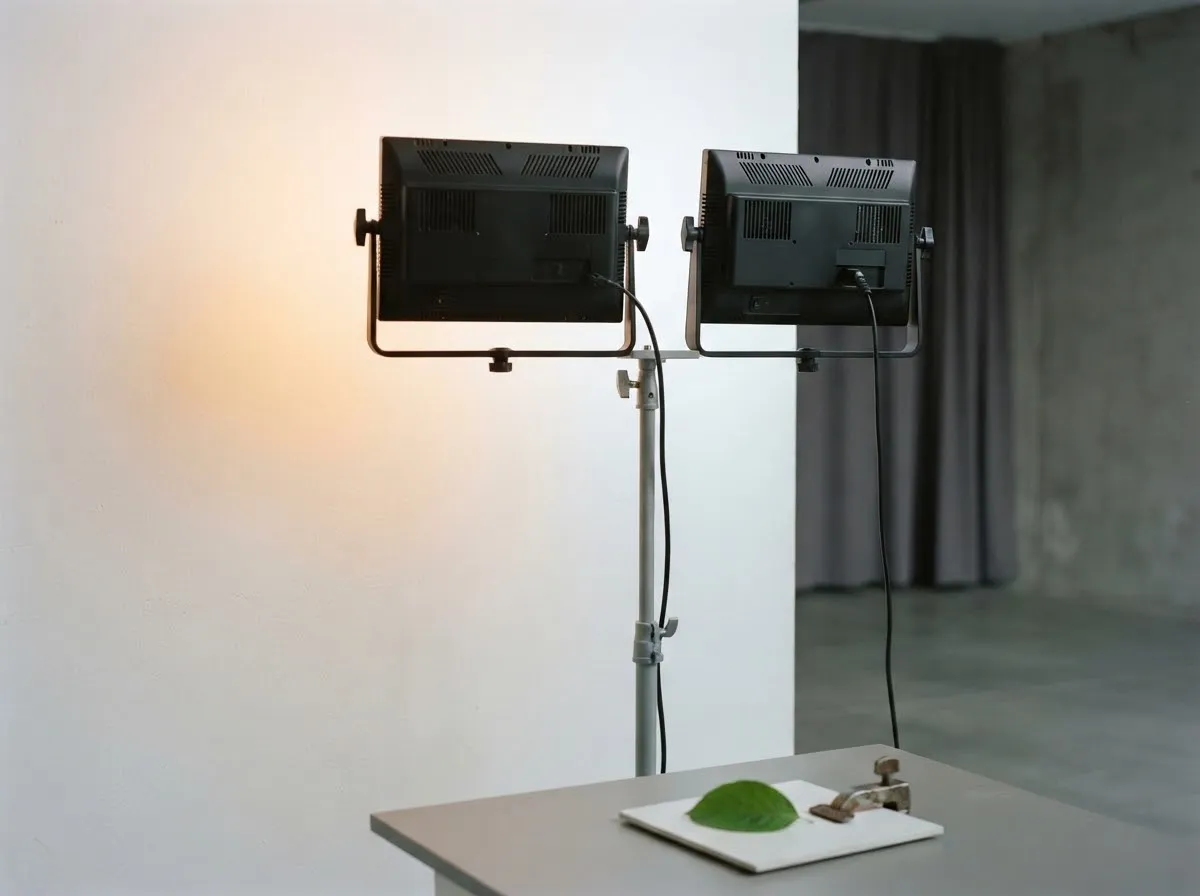
A bi-color LED fixture combines two sets of white LEDs—one warm (around 2700 K–3200 K) and one cool (around 5600 K–6500 K)—and blends their brightness to hit any color temperature in between. In manufacturer naming conventions such as the amaran 100x S & 200x S FAQ, “X” denotes bi-color models, whereas “D” denotes fixed daylight and “C” denotes full-color RGBWW.
Because bi-color lights dedicate their entire emitter array to white light, they keep controls simple (typically one brightness dial and one Kelvin dial) and remain relatively compact. For example, the amaran 60x S spans 2700 K to 6500 K with a CRI of 97, TLCI of 97, and SSI (D32) of 91.
How do RGB and RGBWW LED lights work?
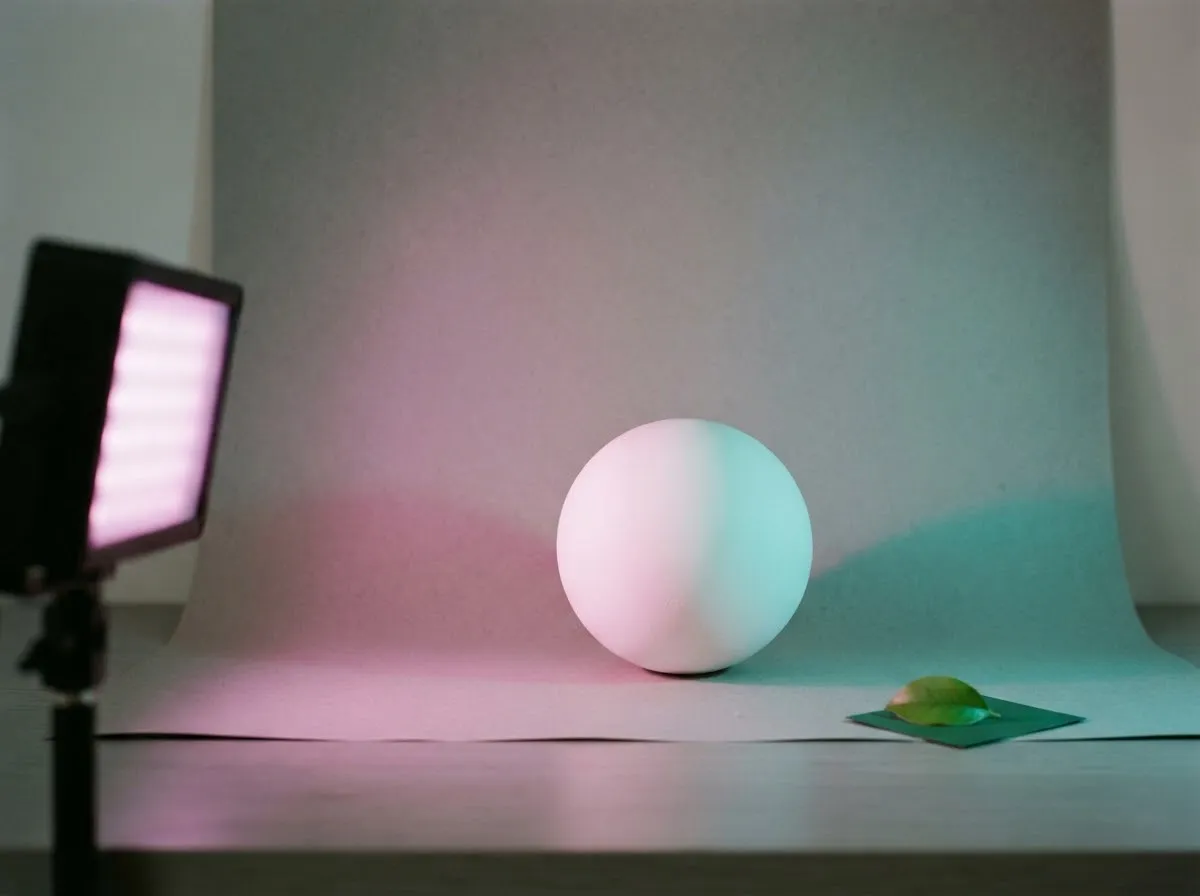
An RGB LED mixes red, green, and blue diodes to create millions of hues using Hue, Saturation, and Intensity (HSI) controls. However, pure RGB lights without white diodes struggle to render accurate skin tones because three narrow color spikes leave gaps in the visible spectrum.
Modern photo and video fixtures solve this with RGBWW (Red, Green, Blue, Warm White, Cool White) chipsets. By keeping dedicated warm-white and cool-white diodes for white light and using the RGB emitters for color, fixtures like the Aputure MC Pro achieve CRI and TLCI scores of 96 while expanding their CCT range to 2,000 K–10,000 K.
RGBWW fixtures typically add two features bi-color lights lack:
- Green-magenta (G/M) tint adjustment: Models that include a green-magenta control let you match imperfect ambient lights like office fluorescents without physical correction gels.
- Saturated colors and digital gels: Projects colored background washes, rim accents, or effects like police beacons and firelight.
How do real-world specs compare between bi-color and RGBWW?
Comparing two 60 W panels from the same product family—the bi-color amaran P60x and the RGBWW amaran P60c on Aputure’s specification sheet—shows the real trade-offs:
- Color temperature range: P60x covers 3200 K–6500 K; P60c widens to 2500 K–7500 K.
- Color accuracy: Both achieve CRI ≥ 95 and TLCI ≥ 96–97.
- Output at 1 m (5600 K): P60x measures 5,070 lux; P60c measures 5,900 lux.
- Lamp head weight: P60x weighs 979 g, whereas P60c weighs 1,880 g—nearly double the weight.
If you want to understand how Kelvin values affect your camera’s white balance, check our Kelvin color temperature chart and color temperature and white balance guide.
Which type of LED should you buy?
- Choose a bi-color LED if you mostly shoot interviews, portraits, video call lighting, or product photos where clean white light is all you need and lighter weight matters.
- Choose an RGBWW LED if you shoot creative YouTube backdrops, music videos, or mixed-lighting locations where green-magenta tint control saves time. Avoid cheap RGB-only lights without dedicated white diodes if you plan to use them as a key light on skin.
For more on choosing your first continuous fixture, read continuous LED lights for beginners and LED panel vs ring light. Always follow the manufacturer’s manual for power and ventilation. Details on our fact-checking process are in our editorial policy.
| Attribute | Bi-color LED | RGB / RGBWW LED |
|---|---|---|
| LED emitters | Warm white + cool white | Red, green, blue (+ warm/cool white in RGBWW) |
| Typical CCT range | 2700 K – 6500 K or 3200 K – 6500 K | 2000 K – 10,000 K or 2500 K – 7500 K |
| Color modes | White CCT only | White CCT + HSI, RGB, XY, and digital gel presets |
| Green-magenta (G/M) tint | Usually not offered | Offered on some models (e.g., a ±G control in the MC Pro color mode) |
| Color accuracy | High CRI/TLCI (e.g., 95–97) on quality panels | High on RGBWW; lower on cheap RGB-only fixtures |
| Weight & complexity | Lighter, simpler two-knob interface | Heavier, deeper menu or app control |
Choose a bi-color LED if you primarily light people, products, or talking-head videos and want a lighter, simpler fixture. Choose an RGBWW LED if you need colored background washes, practical effects, or green-magenta tint matching.
Common questions
What is the difference between bi-color and RGB LED lights?
A bi-color LED mixes warm-white and cool-white diodes to produce adjustable white light from tungsten (~3200 K) to daylight (~5600 K–6500 K). An RGB or RGBWW LED adds red, green, and blue diodes so you can also project saturated colors, digital gel presets, and built-in lighting effects.
Is an RGBWW light better than a plain RGB light for skin tones?
Yes, RGBWW lights include dedicated warm-white and cool-white diodes alongside red, green, and blue emitters, whereas plain RGB lights try to fake white by mixing only three narrow spikes. Dedicated white diodes fill out the spectrum, which is why RGBWW fixtures can reach CRI and TLCI scores of 96 or higher. Published scores vary by model, so compare the CRI, TLCI, and SSI figures on each spec sheet.
Do bi-color LED lights get dimmer at 3200 K or 5600 K?
Output can differ across a bi-color fixture's Kelvin range, so check the spec sheet at the color temperature you plan to use. For example, the amaran P60x measures 5,070 lux at 1 m at 5600 K versus 4,860 lux at 3200 K.
When do you actually need an RGB video light?
You need an RGB or RGBWW light when you want colored background accents, neon or fire effects, or the ability to shift green-magenta tint to match fluorescent or mixed ambient lights. If you only shoot natural-looking interviews or product photos, a bi-color fixture covers your needs.
What do D, X, and C mean in LED light model names?
On many studio LED lines—such as Aputure's amaran series—'D' stands for fixed daylight-balanced output (around 5600 K), 'X' stands for bi-color output (adjustable between warm tungsten and cool daylight), and 'C' stands for full-color RGBWW output capable of both tunable white light and saturated hues.
What we checked
- Aputure Help Center — amaran P60x & P60c Photometrics & Technical Specifications (checked 2026-11-14) (help.aputure.com)
- Aputure Help Center — amaran 60x S Photometrics & Technical Specifications (checked 2026-11-14) (help.aputure.com)
- Aputure Help Center — MC Pro Overview (checked 2026-11-14) (help.aputure.com)
- Aputure Help Center — amaran 100x S & 200x S FAQs (checked 2026-11-14) (help.aputure.com)
You might also like
- LED vs Strobe vs Speedlight: What to Start With
Compare continuous LED lights, camera speedlights, and studio strobes by output units, shutter sync, color control, and video use to pick your first light.
- Battery vs Mains-Powered Lights for Photo and Video
Compare battery and AC mains-powered photo and video lights on output limits, runtime, cable safety, portability, and fan noise before you buy.
- Budget Photo and Video Lighting Kit Guide
Build a budget photo and video lighting kit around one key light, a modifier, and a stand. Compare starter kit categories by output and control.
- Continuous LED Lights for Beginners
Learn how continuous LED video and photo lights work, how CRI and TLCI ratings affect color accuracy, and how to compare panel and COB fixtures.
- Flash Guide Number Explained
How flash guide numbers work: the GN = distance x f-number formula, meters vs feet, zoom head effects, ISO scaling, and power steps.
- DIY Reflector and Diffuser from Household Materials
Make passive photo and video reflectors and diffusers from foam board, poster board, and sheer fabric without electrical DIY or fire hazards.