LED vs Strobe vs Speedlight: What to Start With
Author: Fiat Lux Guides Editorial Team Reviewer: Fiat Lux Guides Editorial Team Most recently reviewed First published Filed under Lighting Gear
Continuous LEDs stay on so you can shoot both video and stills while seeing shadows in real time, whereas speedlights and studio strobes fire brief, high-output bursts for still photography. Speedlights are compact, battery-powered flashes rated by guide number, while studio strobes deliver higher watt-second energy and faster recycling for controlled sets.
Checked by Fiat Lux Guides’ editorial desk against the cited sources.
Choosing your first artificial light comes down to three distinct categories: continuous LED lights, speedlights (hot-shoe flashes), and studio strobes. Each category solves a different problem, measures its brightness in a different unit, and interacts with your camera shutter in a completely different way.
Understanding those core differences before you buy keeps you from purchasing a flash when you need video light, or buying a small LED panel when you need enough punch to freeze motion outdoors.
Continuous LED vs. flash: the fundamental split
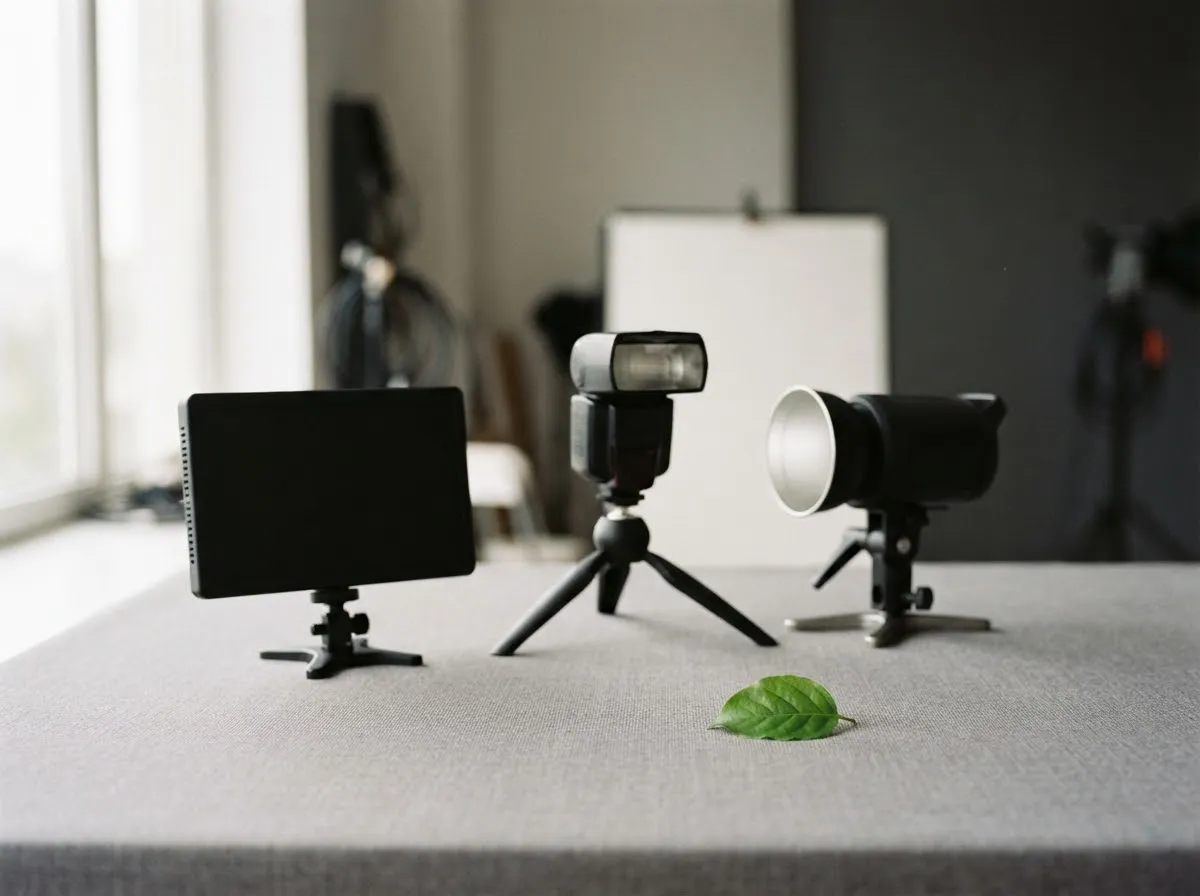
Lighting gear splits into two operating modes:
- Continuous lights (LEDs) stay illuminated the entire time they are switched on. Because the light is constant, you see every highlight and shadow in real time through your viewfinder or on your monitor, and you can record video at any frame rate.
- Flash units (speedlights and studio strobes) store electrical energy in a capacitor and discharge it in a burst lasting thousandths of a second. You only see the final lighting effect after the shutter fires (though studio strobes include a dimmer continuous modeling lamp to preview shadow placement).
Because flash concentrates its energy into a tiny fraction of a second, a flash delivers dramatically higher peak brightness during a still exposure than an LED of similar size and price. Conversely, if you shoot video calls, YouTube tutorials, or hybrid photo-and-video projects, continuous LEDs are the only option that works for motion.
Category 1: Continuous LED lights
Modern continuous lights use Light Emitting Diode (LED) arrays—either flat panels, ring lights, or single-point COB (chip-on-board) fixtures that accept studio modifiers.
How LED specs are written
When you read a manufacturer specification sheet for a continuous LED—such as Aputure’s Light Storm series—three numbers matter most:
- Illuminance (lux at distance): Makers list brightness in lux (or foot-candles) measured at specific distances such as 1 m, 3 m, and 5 m, both bare and with a reflector. Because light follows the inverse-square law, illuminance drops rapidly as you move the fixture back. For instance, the Aputure LS 600c Pro photometric table lists 13,700 lux at 1 m (bare bulb at 3200 K), dropping to 1,638 lux at 3 m and 668 lux at 5 m.
- Correlated Color Temperature (CCT): Daylight-only LEDs are fixed around 5600 K. Bi-color and RGBWW LEDs allow adjustable CCT—for example, 2300 K to 10000 K—so you can match warm indoor bulbs or cool window light without gels.
- Color accuracy (CRI and TLCI): CRI (Color Rendering Index) evaluates color fidelity for human vision, while TLCI (Television Lighting Consistency Index, defined in EBU Tech 3355) evaluates how accurately a camera sensor reproduces colors under that light. The Aputure LS 600c Pro, for example, lists CRI ≥ 95 and TLCI ≥ 98.
For a deeper breakdown of panel vs. COB setups and power options, see continuous LED lights for beginners.
Category 2: Speedlights (camera hot-shoe flashes)
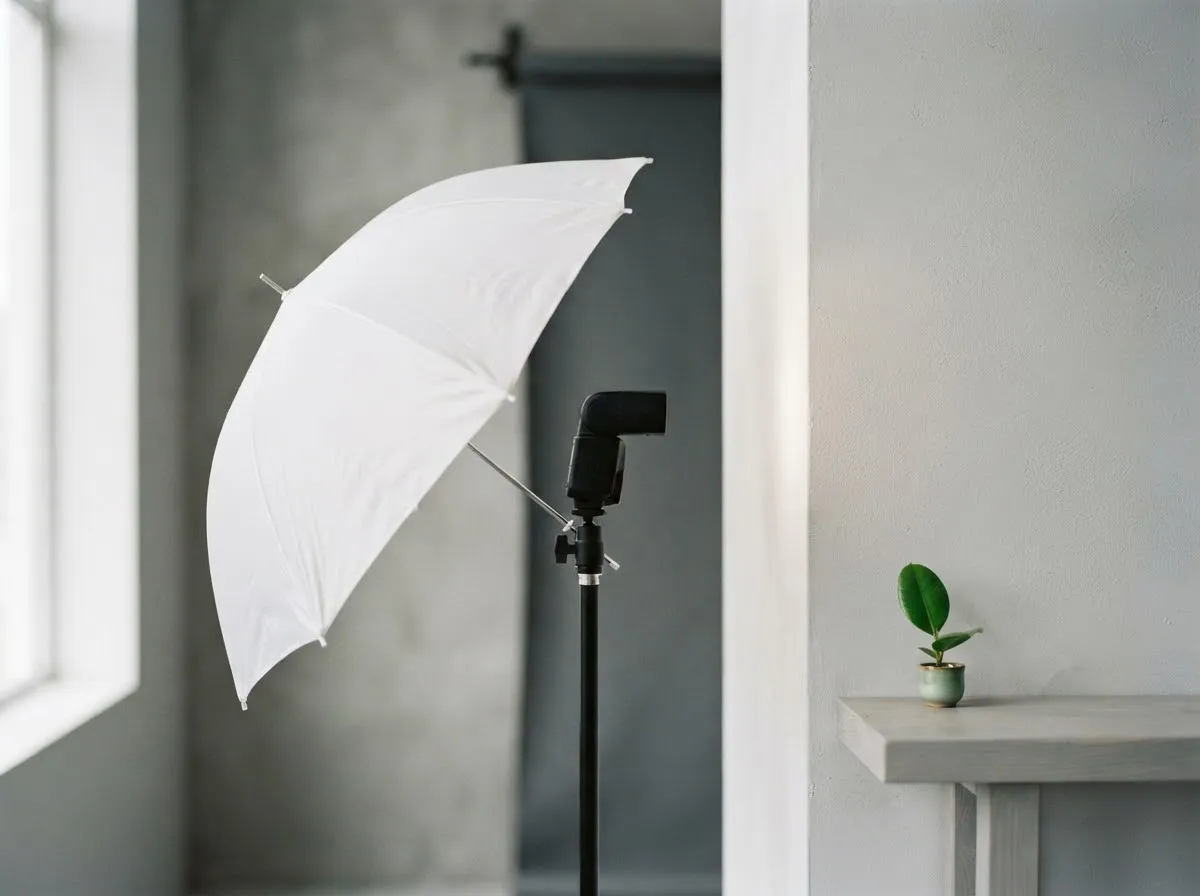
A speedlight is a compact, battery-powered flash designed to slide onto a camera’s hot shoe or trigger wirelessly off-camera on a light stand.
How speedlight specs are written
Speedlight manuals—such as Canon’s Speedlite EL-1 specifications—express power using a Guide Number (GN) at ISO 100 rather than lux or watt-seconds. Because a speedlight’s internal reflector zooms to match lens focal lengths, the guide number increases as the beam narrows: the EL-1 lists a maximum guide number of 27.3 m at 24 mm coverage and 60.0 m at 200 mm coverage (ISO 100).
To estimate exposure manually, divide the guide number by your subject distance (in the same unit, meters or feet) to find the required f-stop at ISO 100. You can run these numbers quickly with our light distance exposure calculator.
Speedlights also adjust output in fractional stops: full power (1/1), 1/2 (−1 stop), 1/4 (−2 stops), 1/8 (−3 stops), and down to 1/128 or lower. Each halving of power reduces the guide number by a factor of √2 (for example, 60.0 m at 1/1 drops to 42.4 m at 1/2 and 30.0 m at 1/4).
Shutter sync and High-Speed Sync (HSS)
Camera manuals such as Canon’s EOS R3 guide explain that a mechanical focal-plane shutter only exposes the entire sensor at once up to its maximum flash sync speed (commonly about 1/160 s to 1/250 s; Canon’s EOS R3 manual lists 1/180 s to 1/250 s depending on shutter mode). Above that speed, the shutter curtains travel as a narrow slit across the sensor, causing dark bands unless you enable High-Speed Sync (HSS). HSS pulses the flash continuously as the slit travels, which lets you shoot at 1/1000 s or faster at the cost of significantly lower effective guide number.
Category 3: Studio strobes (monolights)
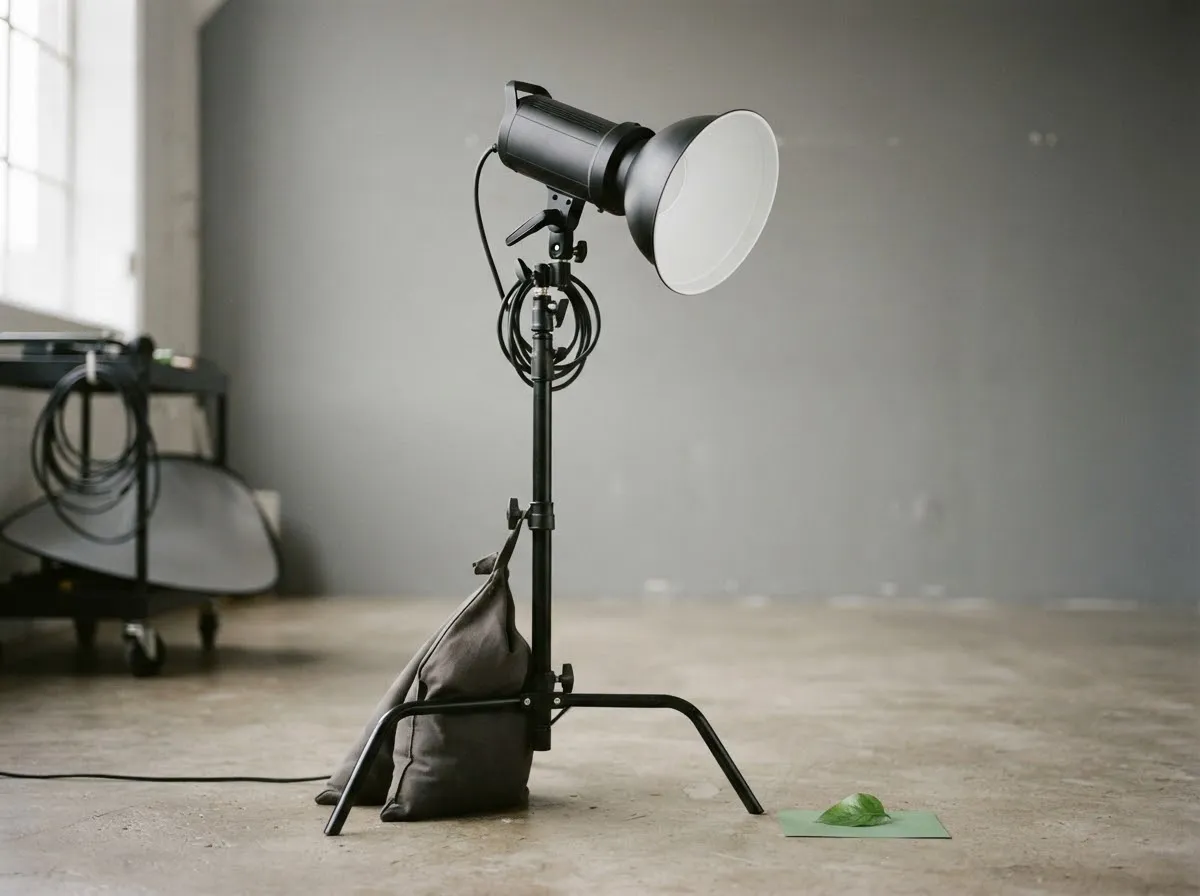
A studio strobe (or monolight) is a larger, stand-mounted flash unit powered by an AC wall outlet or a high-capacity battery pack.
How studio strobe specs are written
Unlike speedlights, studio strobes do not have zooming heads; they accept interchangeable reflectors, umbrellas, and softboxes. Manufacturers therefore rate strobe energy in watt-seconds (Ws)—larger units carry more stored energy—and typically specify a power-adjustment range in f-stops.
Because studio strobes have larger capacitors and active cooling, they recycle faster at medium power than battery-operated speedlights and include a built-in modeling lamp so you can preview shadow angles before firing. Compare both flash types in detail in on-camera flash versus studio flash.
When using AC mains-powered studio strobes or high-wattage LEDs, follow the manufacturer’s manual for power cables, ventilation clearances, and light-stand load limits.
What to start with based on what you shoot
- Video calls, YouTube, or hybrid photo + video: Start with a continuous LED (or a softbox-mounted COB LED). You can use it for video immediately, and it pairs directly with three-light setup and video lighting setups.
- Events, travel, or indoor bounce photography: Start with a speedlight. It fits in a camera bag, runs on standard batteries, and bounces off ceilings or walls for fast, portable stills.
- Portraits, products, or bright-daylight stills with large modifiers: Start with a studio strobe. High watt-second output lets you fill large softboxes or overpower bright ambient light at low ISO.
Guides in the Lighting Gear series
- Continuous LED Lights for Beginners — Panels, COB lights, bi-color vs daylight, and how to read lux and TLCI specs.
- Speedlight vs Studio Strobe: Differences That Matter — Power, recycle time, modeling lights, and portability compared.
- Budget Photo and Video Lighting Kit Guide — What belongs in a minimal starter kit (light, stand, modifier) without overspending.
- Light Modifiers Explained: Softboxes, Umbrellas, Reflectors — How modifiers change light spread, softness, and falloff.
For how we verify specifications and standards across our guides, see our fact-checking process.
| Attribute | Continuous LED | Speedlight | Studio Strobe |
|---|---|---|---|
| Output behavior | Constant illumination | Brief flash burst | Brief flash burst (plus modeling lamp) |
| Spec unit in manuals | Lux (at distance), lumens, watts | Guide Number (m or ft at ISO 100) | Watt-seconds (Ws) |
| Video compatibility | Yes (primary choice for video) | No (stills only) | Stills only (modeling lamp is low output) |
| Shutter speed limit | Any shutter speed (watch for flicker) | Camera flash sync speed (or HSS at lower power) | Camera flash sync speed (or HSS if supported) |
| Color temperature control | Daylight-balanced or adjustable CCT | Fixed flash tube (~5500–6000 K; gels to shift) | Fixed flash tube (~5500–6000 K; gels to shift) |
| Power source | AC mains or V-mount / NP-F batteries | AA or rechargeable Li-ion camera pack | AC mains or high-capacity battery pack |
Start with a continuous LED if you shoot video, calls, or want to preview shadows live. Start with a speedlight for portable still photography, or a studio strobe when you need higher still-image output and faster modifier-ready power.
All Lighting Gear guides
- Battery vs Mains-Powered Lights for Photo and Video
Compare battery and AC mains-powered photo and video lights on output limits, runtime, cable safety, portability, and fan noise before you buy.
- Bi-Color vs RGB LED Lights: What Each Does
Bi-color vs RGB LED lights compared on CCT range, white-light brightness, CRI/TLCI accuracy, green-magenta tint, and creative color modes.
- Budget Photo and Video Lighting Kit Guide
Build a budget photo and video lighting kit around one key light, a modifier, and a stand. Compare starter kit categories by output and control.
- Continuous LED Lights for Beginners
Learn how continuous LED video and photo lights work, how CRI and TLCI ratings affect color accuracy, and how to compare panel and COB fixtures.
- DIY Reflector and Diffuser from Household Materials
Make passive photo and video reflectors and diffusers from foam board, poster board, and sheer fabric without electrical DIY or fire hazards.
- Flash Guide Number Explained
How flash guide numbers work: the GN = distance x f-number formula, meters vs feet, zoom head effects, ISO scaling, and power steps.
- Flash Sync Speed and High-Speed Sync Explained
Learn what flash sync speed is, why black bars appear above it, how high-speed sync works, and when to use HSS or an ND filter.
- LED Panel vs Ring Light for Photo and Video
LED panel vs ring light compared on shadow direction, catchlights, output, color control, and video call or portrait use cases.
- Light Modifiers Explained: Softboxes, Umbrellas, Reflectors
Compare softboxes, umbrellas, and 5-in-1 reflectors on light spread, shadow softness, spill control, and portability for photo and video.
- Softbox vs Umbrella: Light Quality and Control
Compare softboxes and umbrellas on light spread, spill control, setup speed, and catchlights to choose the right modifier for your shoot.
- Speedlight vs Studio Strobe: Differences That Matter
Compare speedlights and studio strobes on power output, recycle time, modeling lamps, modifier mounts, and high-speed sync to pick the right flash.
Common questions
Which lighting type is best if I shoot both photos and video?
A continuous LED light is the only category among the three that works natively for both video and still photography. Speedlights and studio strobes fire a momentary flash burst that cannot illuminate continuous video frames. With an LED fixture, you also see exactly how shadows fall on your subject before pressing the shutter.
Why do speedlights use Guide Number while studio strobes use Watt-seconds?
Camera-mounted speedlights use a zooming flash head, so manufacturers list a Guide Number (GN) in meters or feet at ISO 100 for each focal length setting. Studio strobes are typically used inside umbrellas or softboxes where beam angle changes with the modifier, so manufacturers list stored electrical energy in watt-seconds (Ws) instead.
Can I use a fast shutter speed like 1/2000 second with a flash?
Standard flash sync only works up to your camera's maximum sync speed—commonly in the range of about 1/160 to 1/250 second (Canon's EOS R3 manual, for example, lists 1/180 s to 1/250 s depending on shutter mode)—while the shutter is fully open. Faster shutter speeds require High-Speed Sync (HSS), which pulses the flash rapidly across the frame and reduces maximum flash reach.
Why does flash look much brighter than a similarly priced LED panel?
A flash releases stored capacitor energy in a fraction of a millisecond rather than spreading power continuously over every second. Because a still exposure only needs light during the brief moment the shutter is open, a compact speedlight or studio strobe can overpower bright room light or daylight far more easily than a small LED.
Do I need a bi-color LED or a daylight-only LED to start?
If you shoot mostly near windows or with daylight-balanced room fixtures, a daylight-balanced LED (around 5600 K) gives maximum output for its wattage. A bi-color or RGBWW LED lets you dial color temperature—for example from 2300 K to 10000 K—to match warm indoor lamps without adding color correction gels.
What we checked
- Aputure Help Center: LS 600c Pro Photometrics & Technical Specifications, checked 2026-11-14 (help.aputure.com)
- Canon Speedlite EL-1 Product Manual: Specifications, checked 2026-11-14 (cam.start.canon)
- Canon EOS R3 Product Manual: Flash Function Settings, checked 2026-11-14 (cam.start.canon)
- Canon EOS R6 Product Manual: White Balance, checked 2026-11-14 (cam.start.canon)
- EBU Tech 3355: Method for the Assessment of the Colorimetric Properties of Luminaires in Television (TLCI-2012), checked 2026-11-14 (tech.ebu.ch)
- HyperPhysics (Georgia State University): Inverse Square Law for Light, checked 2026-11-14 (hyperphysics.phy-astr.gsu.edu)
You might also like
- Continuous LED Lights for Beginners
Learn how continuous LED video and photo lights work, how CRI and TLCI ratings affect color accuracy, and how to compare panel and COB fixtures.
- Speedlight vs Studio Strobe: Differences That Matter
Compare speedlights and studio strobes on power output, recycle time, modeling lamps, modifier mounts, and high-speed sync to pick the right flash.
- Budget Photo and Video Lighting Kit Guide
Build a budget photo and video lighting kit around one key light, a modifier, and a stand. Compare starter kit categories by output and control.
- Light Modifiers Explained: Softboxes, Umbrellas, Reflectors
Compare softboxes, umbrellas, and 5-in-1 reflectors on light spread, shadow softness, spill control, and portability for photo and video.
- Three-Point Lighting Explained for Beginners
Learn three-point lighting—key light, fill light, and backlight—plus how source size controls shadow softness and how distance and stops control exposure.
- Battery vs Mains-Powered Lights for Photo and Video
Compare battery and AC mains-powered photo and video lights on output limits, runtime, cable safety, portability, and fan noise before you buy.