Speedlight vs Studio Strobe: Differences That Matter
Author: Fiat Lux Guides Editorial Team Reviewer: Fiat Lux Guides Editorial Team Most recently reviewed First published Filed under Lighting Gear
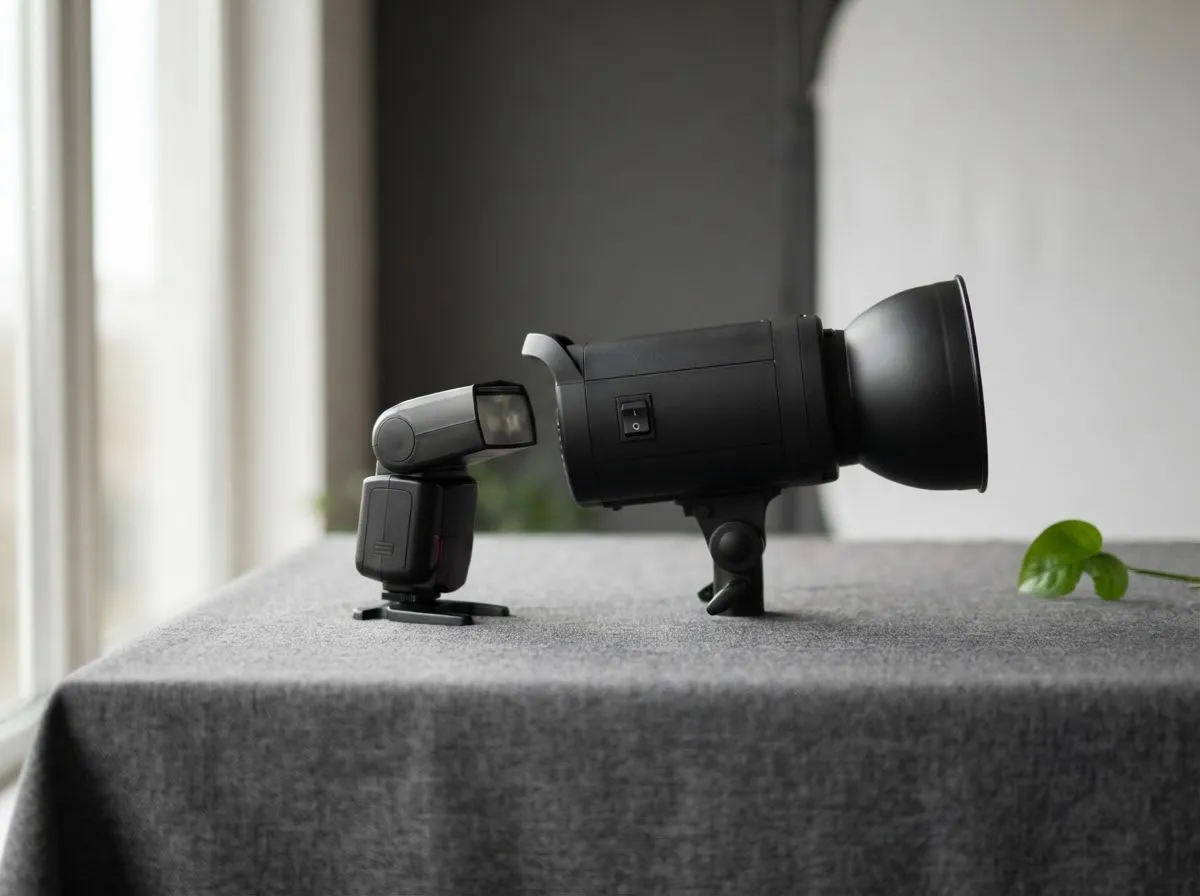
Speedlights are compact, battery-powered camera flashes rated by guide number, while studio strobes are larger monolights or pack-and-head units rated in watt-seconds (Ws) with built-in modeling lamps and faster full-power recycle times. Choose a speedlight for hot-shoe portability and tight budgets, or a studio strobe for big modifiers, rapid shooting, and overpowering bright sun.
Belongs to the guide: LED vs Strobe vs Speedlight: What to Start With
Checked by Fiat Lux Guides’ editorial desk against the cited sources.
Inside our LED vs strobe vs speedlight pillar guide, flash splits into two distinct families: speedlights (compact camera-top flashes) and studio strobes (larger stand-mounted monolights or pack-and-head systems). Both freeze motion with a brief pulse of daylight-balanced light, yet they differ sharply in power output, recycle speed, modifier compatibility, and portability. Understanding those category differences helps you buy once for the way you actually shoot.
Speedlight vs. Studio Strobe at a Glance
| Attribute | Speedlight (Hot-Shoe Flash) | Studio Strobe (Monolight) |
|---|---|---|
| Output rating | Guide Number (meters or feet at ISO 100) | Watt-seconds / Joules (commonly 100–600+ Ws) |
| Power source | AA batteries or compact Li-ion pack | AC mains wall power or high-capacity Li-ion battery |
| Full-power recycle time | Slower under sustained 1/1 firing; thermal limits | Fast (the two example units below list 0.01–0.9 s and 0.01–1.5 s) |
| Modeling lamp | Usually none | Built-in continuous LED or halogen modeling lamp |
| Modifier mount | Requires S-type bracket or clamp adapter | Native Bowens or proprietary studio mount |
| Portability | Fits in a camera bag; mounts on hot shoe or stand | Requires a light stand; heavier and bulkier |
Verdict: Choose a speedlight when you need one compact flash for events, travel, or hot-shoe bounce work; choose a studio strobe when you shoot through large softboxes, need fast recycle times, or want to overpower midday sunlight.
Output Power: Guide Numbers vs. Watt-Seconds
Speedlights and studio strobes do not even measure output in the same units:
- Speedlights use Guide Numbers (GN): Camera-maker manuals publish a table of guide numbers in meters or feet at ISO 100 across zoom head positions. For instance, Sony’s HVL-F46RM Help Guide lists a Guide Number of 30 m at its 50 mm zoom setting (full 1/1 power, ISO 100), stepping down in half-power increments through 1/2, 1/4, 1/8, 1/16, 1/32, 1/64, and 1/128. Advanced speedlights like the Canon Speedlite EL-1 even step down in 1/3-stop increments to 1/8192 power for close-up work. You can convert any guide number into a working f-stop with our light distance exposure calculator.
- Studio strobes use Watt-Seconds (Ws / Joules): Studio monolights state the electrical energy stored in their capacitors—commonly 300 Ws to 600 Ws for portable or single-head units, and higher for studio packs. A studio strobe puts out substantially more raw light than a speedlight, giving you headroom when shooting through large double-diffused softboxes or balancing flash against direct outdoor sun.
Recycle Time and Burst Consistency
Recycle time is how long a flash takes to recharge its capacitor after firing before it can fire again at the same power.
- Speedlights: Powered by four AA cells or a small Li-ion battery, speedlights recycle quickly at low power (1/16 or 1/32) but take noticeably longer after full 1/1 pops. Repeated full-power bursts also heat up the flash tube and electronics, triggering thermal protection lockouts on many models.
- Studio strobes: Designed for heavy stand-mounted shooting, studio strobes recharge rapidly. For example, the battery-powered Godox AD300ProII specifies a 0.01–1.5 second recycle time and roughly 350 full-power flashes per charge, while an AC-powered monolight like the Profoto D30 lists a recycle time of 0.01–0.9 seconds, depending on mains voltage.
For AC mains-powered studio strobes, always follow the manufacturer’s operating manual and consult a licensed electrician for any mains wiring work.
Modeling Lamps and Modifier Compatibility
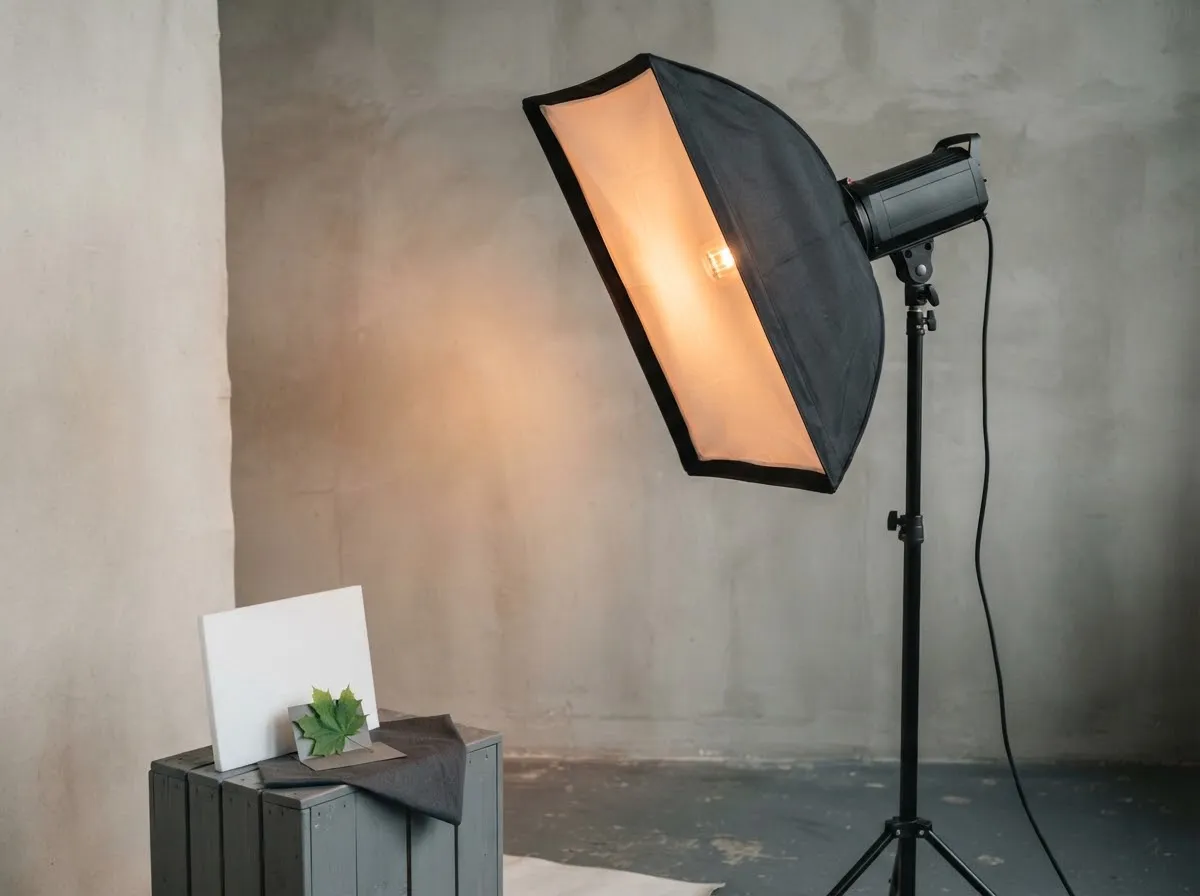
A modeling lamp is a small continuous light built into the front of a studio strobe so you can see where shadows and highlights fall before you press the shutter. Most studio strobes include a continuous LED or halogen modeling lamp, whereas most speedlights omit one. (If you want full-time live preview without flash at all, compare continuous LED lights for beginners.)
Modifier mounting is the other major practical divide:
- Studio strobes feature an integrated reflector mount (such as a Bowens S-mount or a maker’s proprietary mount) that locks heavy softboxes, octaboxes, and beauty dishes directly onto the body, and their exposed bare-bulb flashtube spreads light evenly inside a modifier.
- Speedlights have a narrow rectangular Fresnel lens built to zoom with a camera lens. To use a studio softbox, you clamp the speedlight into an adapter bracket; even then, the directional Fresnel lens fills large modifiers less evenly unless you add a small dome or push the head slightly back.
Flash Sync Speed and High-Speed Sync (HSS)
Both speedlights and studio strobes are subject to your camera’s mechanical flash sync speed. As Nikon’s Z8 Flash Sync Speed manual explains, the flash sync speed options top out at 1/200 s or 1/250 s (with Auto FP high-speed sync available above that); faster shutter speeds on a focal-plane shutter expose the sensor through a moving slit rather than all at once.
When you want to shoot wider apertures outdoors in bright light—requiring shutter speeds faster than 1/250 s—compatible speedlights and modern studio strobes support High-Speed Sync (HSS / Auto FP). HSS fires a rapid series of tiny pulses as the shutter slit travels across the frame, which lets you shoot at shutter speeds as fast as 1/8000 s on the Nikon Z8 at the cost of reduced effective flash range.
Which One Should Beginners Buy First?
- Start with a speedlight if: You shoot events, travel, or family gatherings; want a flash you can slide onto your camera’s hot shoe and bounce off a white ceiling; or want an affordable entry point into off-camera flash with a light stand and an umbrella.
- Start with a studio strobe if: You primarily shoot portraits, headshots, or products in a home studio or on location with a light stand; plan to use medium-to-large softboxes; need fast recycle times without thermal lockouts; or want a modeling lamp to help you learn shadow placement. Strobes are generally daylight-balanced, which you can preview against camera presets in our Kelvin values by light source.
Both categories obey the same inverse square law of light falloff, so moving either a speedlight or a strobe closer to your subject softens shadows and increases exposure rapidly. Start with a single light and a simple modifier, learn how distance and angle shape the subject, and add extra units only when your shots call for rim or background separation.
For details on how we source and verify all camera and lighting specifications, see our editorial policy.
Frequently Asked Questions
How much more powerful is a studio strobe than a speedlight?
A typical studio strobe has considerably more light output than a camera-top speedlight. While speedlights are rated by guide number at ISO 100 rather than watt-seconds, entry-level studio monolights commonly start around 300 Ws to 500 Ws, giving you enough reserve power to fill large softboxes or shoot outdoors in bright sun.
Why do studio strobes recycle faster than speedlights?
Studio strobes use larger capacitors and either AC wall power or high-voltage lithium battery packs built to handle rapid heat dissipation. For example, a 500 Ws AC monolight like the Profoto D30 lists a recycle time of 0.01 to 0.9 seconds depending on mains voltage, whereas AA-powered speedlights slow down and can overheat during repeated full-power bursts.
Do I need a modeling lamp on a flash?
A modeling lamp is not required to take a photo, but it makes lighting setup much faster because you can preview shadow angles and catchlights before firing a test frame. Most studio strobes include a continuous LED or halogen modeling lamp inside the modifier, whereas most speedlights do not.
Can you use studio softboxes with a speedlight?
Yes, by mounting the speedlight inside a bracket—such as an S-type Bowens bracket—that clamps around the flash head and provides a standard modifier ring. Because a speedlight’s bare head is rectangular and smaller than a strobe’s bare bulb, it fills large softboxes less evenly unless paired with an internal diffuser.
What is flash sync speed and how does it affect speedlights and strobes?
Flash sync speed is the fastest shutter speed at which your camera’s focal-plane shutter opens completely—commonly 1/200 s or 1/250 s on modern mirrorless and DSLR bodies. Shooting faster than sync speed typically requires High-Speed Sync (HSS / Auto FP), which pulses the flash rapidly and reduces effective output.
Sources
- Sony HVL-F46RM / HVL-F60RM2 Help Guide: Guide Number Table, checked 2026-11-14
- Canon Speedlite EL-1 Manual: Manual Flash Output Steps, checked 2026-11-14
- Nikon Z8 Reference Manual: Flash Sync Speed (e1), checked 2026-11-14
- Godox AD300ProII Specifications, checked 2026-11-14
- Profoto D30 Specifications, checked 2026-11-14
- HyperPhysics: Inverse Square Law for Light, checked 2026-11-14
| Attribute | Speedlight (Hot-Shoe Flash) | Studio Strobe (Monolight) |
|---|---|---|
| Output rating | Guide Number (meters or feet at ISO 100) | Watt-seconds / Joules (commonly 100–600+ Ws) |
| Power source | AA batteries or compact Li-ion pack | AC mains wall power or high-capacity Li-ion battery |
| Full-power recycle time | Slower under sustained 1/1 firing; thermal limits | Fast (the two example units below list 0.01–0.9 s and 0.01–1.5 s) |
| Modeling lamp | Usually none (brief stroboscopic preview on some) | Built-in continuous LED or halogen modeling lamp |
| Modifier mount | Requires S-type bracket or clamp adapter | Native Bowens or proprietary studio mount |
| Portability | Fits in a camera bag; mounts on hot shoe or light stand | Requires a light stand; heavier and bulkier |
Choose a speedlight when you need one compact flash for events, travel, or hot-shoe bounce work; choose a studio strobe when you shoot through large softboxes, need fast recycle times, or want to overpower midday sunlight.
Common questions
How much more powerful is a studio strobe than a speedlight?
A typical studio strobe has considerably more light output than a camera-top speedlight. While speedlights are rated by guide number at ISO 100 rather than watt-seconds, entry-level studio monolights commonly start around 300 Ws to 500 Ws, giving you enough reserve power to fill large softboxes or shoot outdoors in bright sun.
Why do studio strobes recycle faster than speedlights?
Studio strobes use larger capacitors and either AC wall power or high-voltage lithium battery packs built to handle rapid heat dissipation. For example, a 500 Ws AC monolight like the Profoto D30 lists a recycle time of 0.01 to 0.9 seconds depending on mains voltage, whereas AA-powered speedlights slow down and can overheat during repeated full-power bursts.
Do I need a modeling lamp on a flash?
A modeling lamp is not required to take a photo, but it makes lighting setup much faster because you can preview shadow angles and catchlights before firing a test frame. Most studio strobes include a continuous LED or halogen modeling lamp inside the modifier, whereas most speedlights do not.
Can you use studio softboxes with a speedlight?
Yes, by mounting the speedlight inside a bracket—such as an S-type Bowens bracket—that clamps around the flash head and provides a standard modifier ring. Because a speedlight's bare head is rectangular and smaller than a strobe's bare bulb, it fills large softboxes less evenly unless paired with an internal diffuser.
What is flash sync speed and how does it affect speedlights and strobes?
Flash sync speed is the fastest shutter speed at which your camera's focal-plane shutter opens completely—commonly 1/200 s or 1/250 s on modern mirrorless and DSLR bodies. Shooting faster than sync speed typically requires High-Speed Sync (HSS / Auto FP), which pulses the flash rapidly and reduces effective output.
What we checked
- Sony HVL-F46RM / HVL-F60RM2 Help Guide: Guide Number Table, checked 2026-11-14 (helpguide.sony.net)
- Canon Speedlite EL-1 Manual: Manual Flash Output Steps, checked 2026-11-14 (cam.start.canon)
- Nikon Z8 Reference Manual: Flash Sync Speed (e1), checked 2026-11-14 (onlinemanual.nikonimglib.com)
- Godox AD300ProII Specifications, checked 2026-11-14 (godox.com)
- Profoto D30 Specifications, checked 2026-11-14 (profoto.com)
- HyperPhysics: Inverse Square Law for Light, checked 2026-11-14 (hyperphysics.gsu.edu)
You might also like
- LED vs Strobe vs Speedlight: What to Start With
Compare continuous LED lights, camera speedlights, and studio strobes by output units, shutter sync, color control, and video use to pick your first light.
- Battery vs Mains-Powered Lights for Photo and Video
Compare battery and AC mains-powered photo and video lights on output limits, runtime, cable safety, portability, and fan noise before you buy.
- Bi-Color vs RGB LED Lights: What Each Does
Bi-color vs RGB LED lights compared on CCT range, white-light brightness, CRI/TLCI accuracy, green-magenta tint, and creative color modes.
- Budget Photo and Video Lighting Kit Guide
Build a budget photo and video lighting kit around one key light, a modifier, and a stand. Compare starter kit categories by output and control.
- Continuous LED Lights for Beginners
Learn how continuous LED video and photo lights work, how CRI and TLCI ratings affect color accuracy, and how to compare panel and COB fixtures.
- Flash Guide Number Explained
How flash guide numbers work: the GN = distance x f-number formula, meters vs feet, zoom head effects, ISO scaling, and power steps.