Budget Photo and Video Lighting Kit Guide
Author: Fiat Lux Guides Editorial Team Reviewer: Fiat Lux Guides Editorial Team Most recently reviewed First published Filed under Lighting Gear
A practical budget lighting kit for photography and video starts with one controllable light source, one large modifier, a stable stand, and a collapsible reflector for fill. Buying one higher-output fixture with a standard Bowens or umbrella mount outperforms a cheap three-light bundle with fixed bulbs and flimsy stands.
Belongs to the guide: LED vs Strobe vs Speedlight: What to Start With
Building a budget lighting kit for photography and video does not require buying a three-head studio bundle on day one. Before picking individual pieces, review our pillar comparison of LED vs strobe vs speedlight to match the light technology to what you shoot. Most beginners get cleaner, more predictable results by putting their budget into one controllable key light, one large modifier, one solid stand, and one passive reflector rather than splitting the same money across three underpowered fixtures.
When you start with one light and a bounce surface, you learn how light direction, source size, and distance shape shadows without fighting conflicting color casts or cramped cables. You can always add a second light later as a rim or background accent once your key light setup is consistent.
What belongs in a starter lighting kit?
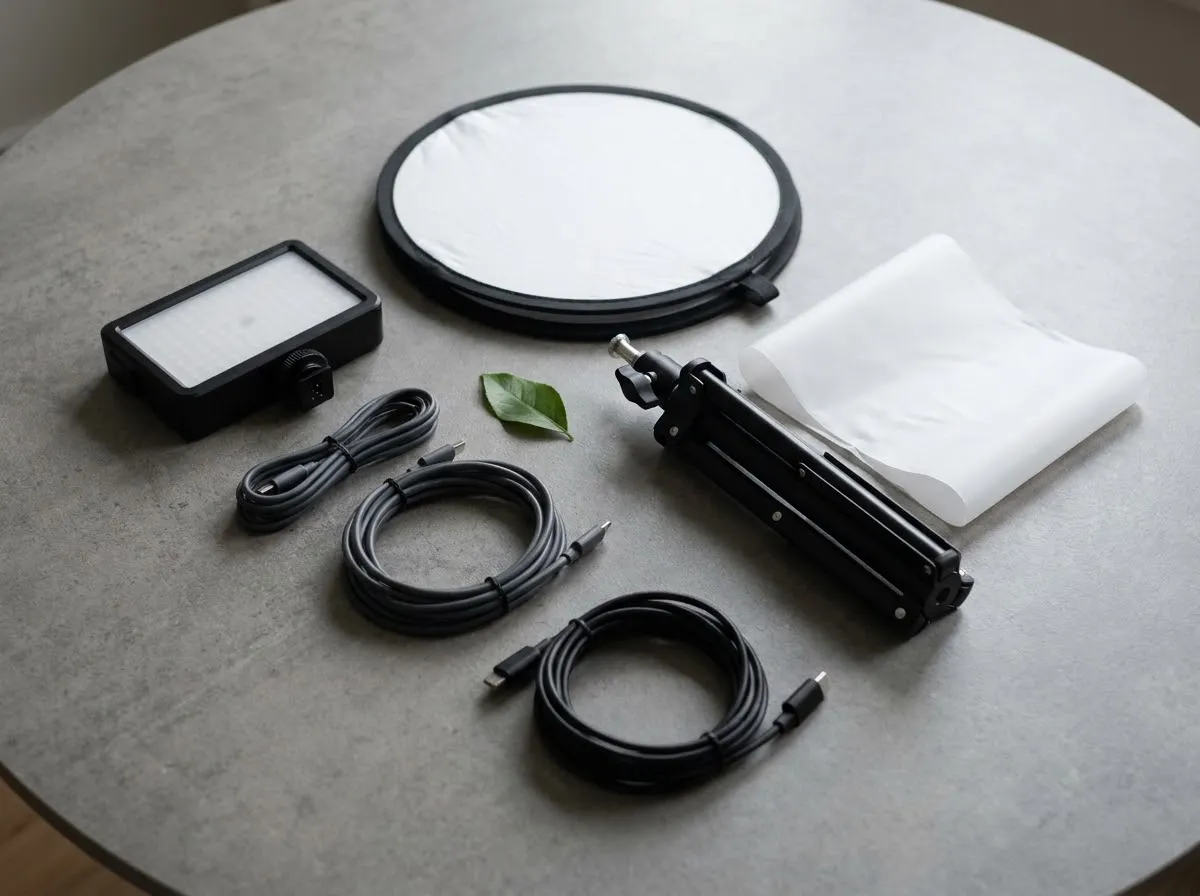
Every functional starter kit solves four jobs: generating light, shaping its softness, holding it safely at the right height, and controlling the shadow side.
- One primary light source (key light): Either a dimmable continuous LED (for video, calls, and hybrid stills) or a manual speedlight with a wireless radio trigger (for stills only).
- One large modifier: A 43- to 45-inch convertible umbrella or a 60 to 90 cm (24 to 36 inch) quick-fold softbox. Larger modifiers produce softer shadow transitions when placed close to the subject.
- One sturdy stand and bracket: An air-cushioned or wide-footprint light stand rated well above the combined weight of your light and modifier, plus a tilt bracket with an umbrella socket or Bowens mount.
- One 5-in-1 collapsible reflector: As documented on Westcott’s 5-in-1 reflector specifications, a single collapsible frame gives you a full-stop diffusion disc plus a reversible cover with silver, sunlight (gold), white, and black surfaces.
If your budget is tight, skip extra colored RGB tubes, cheap plastic barn doors, and flimsy mini-tripods. Put that money into a heavier stand and a larger modifier—both outlast your first light body.
Comparing starter kit categories by use case
The right kit category depends on whether you shoot still frames, continuous video, or both.
| Kit Category | Primary Use | Color Control | Power & Portability | Modifier Ecosystem |
|---|---|---|---|---|
| Continuous Bi-Color COB LED (1 light + softbox) | Video, YouTube, product, hybrid stills | Variable CCT (typically 2700K–6500K) | AC adapter or battery packs | Standard Bowens S-mount or umbrella hole |
| Compact Desktop LED Panel | Video calls, desk streaming, small tabletop | Variable CCT (often 2700K–6500K) | USB-C or AC wall adapter | Built-in diffuser; limited external modifiers |
| Manual Speedlight + Trigger + Umbrella | Still portraits, events, on-location flash | Fixed daylight (~5400K–6000K) | AA or Li-ion batteries; highly portable | Umbrella bracket or speedlight softbox |
| Entry AC Studio Strobe + Softbox | Indoor portraits, studio stills | Fixed daylight (check datasheet) | AC mains cord only | Bowens S-mount softboxes and reflectors |
Continuous bi-color COB LED kits
A compact point-source LED (often called a COB, or chip-on-board, fixture) gives you the most flexibility if you shoot both video and photos. Many bi-color units offer a variable correlated color temperature (CCT) range of 2700K to 6500K and CRI/TLCI ratings in the mid-90s—for example, Aputure lists 2700K–6500K and CRI/TLCI of 96 or higher on Aputure’s bi-color COB specifications. Because the LED emitter sits at the front of a Bowens S-mount, you can attach full-size softboxes, umbrellas, and reflectors. Read our continuous LED lights for beginners guide for output and noise checks before buying.
Compact desktop LED panels
If your main goal is looking sharp on webcam meetings or desk-bound streams, a small panel with a built-in diffuser—such as the one Logitech describes on its Litra Glow page (a precision-optics lens with a frameless diffuser)—sits at desk level. It saves floor space, though its smaller luminous surface means it must stay close to your face to keep shadows soft. See our video call lighting guide for exact monitor-height placement.
Manual speedlight kits
For still photography on a tight budget, a manual speedlight paired with a radio trigger and an umbrella delivers far more peak light per dollar than an entry-level LED. Camera manuals such as the Canon EOS-1D X Mark III manual note that flash is balanced near daylight (Canon fixes it at approximately 6000 K without color temperature transmission; Nikon lists Flash at 5400 K). You cannot use a speedlight for video, but for portraits it lets you shoot at base ISO (such as ISO 100) and narrower apertures without motion blur. Compare flash options in speedlights compared with studio strobes.
Entry AC studio strobes
AC-powered monolights plug into a wall outlet and recycle faster at higher power than AA-powered speedlights. They usually include a Bowens mount for large softboxes and a modeling lamp to preview shadow placement. The trade-off is portability: you need an AC outlet nearby.
Specs that actually matter on a manufacturer datasheet
Ignore marketing phrases like “1000W equivalent” or “studio pro brightness.” Look for four concrete numbers on the maker’s spec sheet:
- CRI and TLCI: Aim for CRI and TLCI in the mid-90s or higher on continuous LEDs, and confirm the figure is published on the datasheet.
- CCT range: Fixed daylight (5600K) is fine if you shoot in a controlled room or match window light, while bi-color (2700K–6500K) lets you match warm household lamps without gels.
- Dimming steps and minimum output: Smooth dimming down to 1% (for LEDs) or 1/128 power (for flash) matters when you place a light close to your subject in a small room.
- Standard mount: A Bowens S-mount or standard umbrella shaft receiver ensures your light modifiers stay compatible even if you upgrade the light body later.
How distance multiplies a budget light’s power
A low-output budget light can still expose cleanly at low ISO if you place it close to your subject. Under the HyperPhysics inverse-square law, light intensity from a small source varies inversely with the square of the distance. Moving a light from 2 meters away to 1 meter away quadruples the illuminance on your subject—a gain of two full stops of exposure without spending a cent on a brighter fixture. Use our light distance exposure calculator to see exact stop changes before buying higher-wattage gear.
Safety notes for budget lighting setups
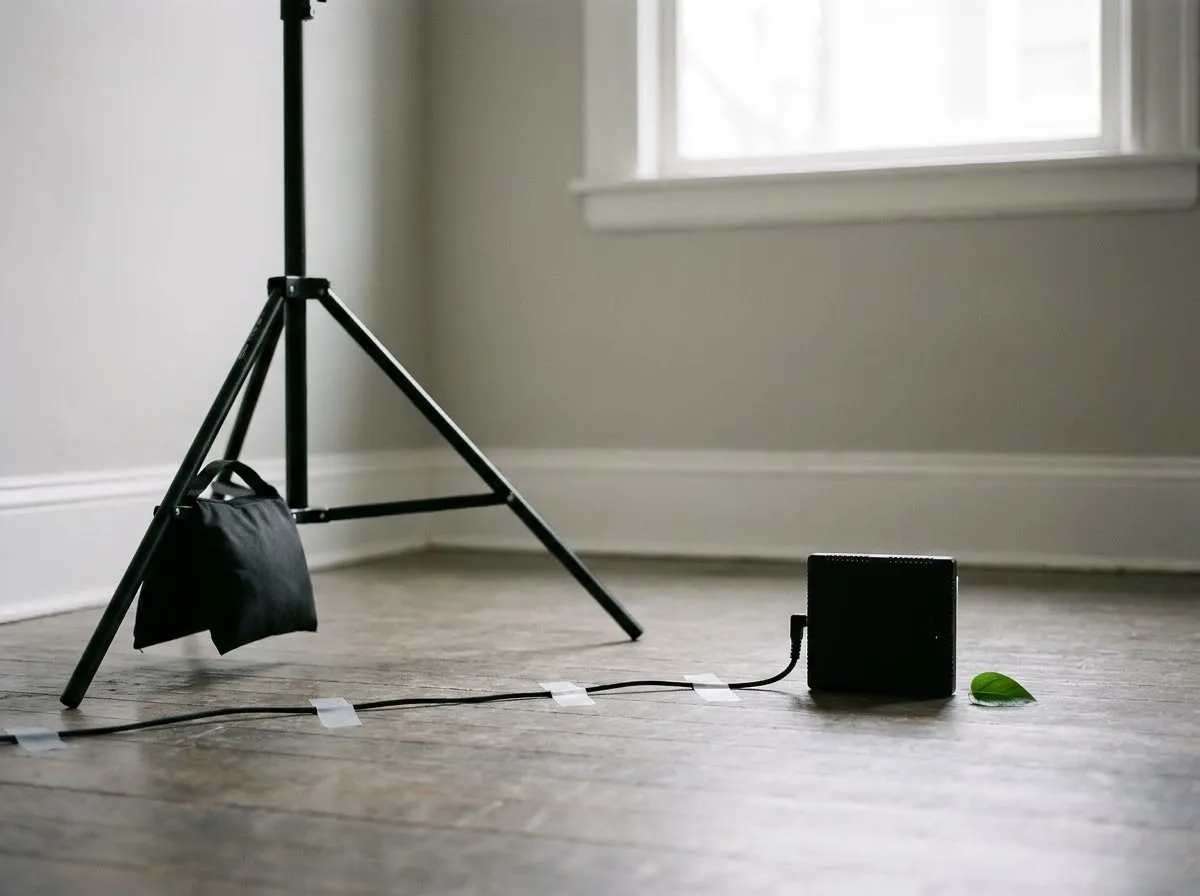
Follow the manufacturer’s manual for power cables, battery charging, and ventilation clearances on every fixture. Never cover cooling vents on a continuous LED or strobe with cloth or non-heat-resistant diffusion. If you ever need dedicated circuits or hardwired wall outlets for a home studio space, consult a licensed electrician for any mains-wiring work. For how we verify manufacturer specifications, see our sourcing and review approach.
Next steps as your kit grows
Once you master one key light and a 5-in-1 reflector, your second purchase should usually be a second modifier (such as a gridded softbox for spill control) or a compact second light for hair/background separation in a three-point lighting setup. Check our video lighting setup hub if your primary goal is YouTube or talking-head recording.
| Kit Category | Primary Use | Color Control | Power & Portability | Modifier Ecosystem |
|---|---|---|---|---|
| Continuous Bi-Color COB LED (1 light + softbox) | Video, talking-head, product, hybrid photo | Variable CCT (typically 2700K to 6500K) | AC adapter or V-mount/NP-F batteries | Standard Bowens S-mount or umbrella hole |
| Compact Desktop LED Panel | Video calls, desk streaming, small tabletop | Variable CCT (often 2700K to 6500K) | USB-C or AC wall adapter | Built-in diffuser; limited external modifiers |
| Manual Speedlight + Wireless Trigger + Umbrella | Still portraits, events, on-location flash | Fixed daylight balance (~5400K to 6000K) | AA or Li-ion pack; highly portable | Umbrella bracket or speedlight softbox adapter |
| Entry AC Studio Strobe + Softbox | Indoor portraits, studio stills | Fixed daylight balance (check the datasheet) | AC mains cord only; tethered to wall outlet | Bowens S-mount softboxes and reflectors |
Choose a single bi-color COB LED with a Bowens mount if you shoot both video and stills. Choose a manual speedlight with an umbrella bracket if you shoot stills only and need battery portability or high-power freeze.
Common questions
What is the best starter lighting kit for photography and video?
A single-light kit built around one bi-color COB LED (or one manual speedlight for stills only), a 60 to 90 cm softbox or 45-inch umbrella, a sturdy light stand, and a 5-in-1 collapsible reflector covers most beginner setups. Starting with one controllable key light and a passive reflector teaches shadow placement faster than managing three weak fixtures.
Should I buy a three-light budget bundle or one better light?
Buying one higher-quality light with a standard Bowens mount and a sturdy stand is almost always better than a three-light bundle at the same price. Multi-light bargain kits commonly cut corners on stands and bulbs; check each listing for dimming, stand load rating, and a published CRI before you buy.
Can I use continuous LED lights for both photography and video?
Yes, continuous LED lights work for both stills and video, provided your subject is relatively still or you can raise your camera ISO or use a wider aperture. Unlike flash, continuous LEDs let you see shadows in real time on the camera screen, though they deliver less peak light output per watt than a strobe or speedlight.
What light modifiers should be in a budget lighting kit?
Start with either a shoot-through/convertible umbrella or a quick-fold softbox, plus a collapsible 5-in-1 reflector. An umbrella is the least expensive way to make a light source physically larger, while a softbox keeps light from spilling onto nearby walls. The 5-in-1 reflector adds bounce fill, warm gold fill, diffusion, and black negative fill.
What CRI or TLCI rating should a budget video light have?
Look for a published Color Rendering Index (CRI) and Television Lighting Consistency Index (TLCI) in the mid-90s or higher on the manufacturer's datasheet. Lower ratings can indicate gaps in the spectrum that shift colors, and those are hard to fix cleanly in white balance. For reference, Aputure lists CRI and TLCI of 96 or higher on its LS 300x.
Do I need a light meter for a beginner lighting kit?
No, a handheld light meter is not required to start. For continuous LEDs, your camera's live view, histogram, and zebra warnings show exposure immediately. For speedlights and strobes, you can dial manual power up or down in full-stop or third-stop increments while checking the camera histogram.
What we checked
- Aputure LS 300x Technical Specifications (CRI/TLCI, CCT Range, Bowens Mount), checked 2026-11-14 (aputure.com)
- F.J. Westcott Illuminator QuickGrip 5-in-1 Reflector Specifications, checked 2026-11-14 (fjwestcott.com)
- Logitech Litra Glow Technical Overview (Diffusion & Desktop Mounting), checked 2026-11-14 (logitech.com)
- Canon EOS-1D X Mark III Manual — White Balance & Flash Color Temperature, checked 2026-11-14 (cam.start.canon)
- HyperPhysics (Georgia State) — Inverse Square Law, checked 2026-11-14 (hyperphysics.gsu.edu)
You might also like
- LED vs Strobe vs Speedlight: What to Start With
Compare continuous LED lights, camera speedlights, and studio strobes by output units, shutter sync, color control, and video use to pick your first light.
- Battery vs Mains-Powered Lights for Photo and Video
Compare battery and AC mains-powered photo and video lights on output limits, runtime, cable safety, portability, and fan noise before you buy.
- Bi-Color vs RGB LED Lights: What Each Does
Bi-color vs RGB LED lights compared on CCT range, white-light brightness, CRI/TLCI accuracy, green-magenta tint, and creative color modes.
- Continuous LED Lights for Beginners
Learn how continuous LED video and photo lights work, how CRI and TLCI ratings affect color accuracy, and how to compare panel and COB fixtures.
- Flash Guide Number Explained
How flash guide numbers work: the GN = distance x f-number formula, meters vs feet, zoom head effects, ISO scaling, and power steps.
- DIY Reflector and Diffuser from Household Materials
Make passive photo and video reflectors and diffusers from foam board, poster board, and sheer fabric without electrical DIY or fire hazards.