DIY Reflector and Diffuser from Household Materials
Author: Fiat Lux Guides Editorial Team Reviewer: Fiat Lux Guides Editorial Team Most recently reviewed First published Filed under Lighting Gear
You can build effective photo and video reflectors and diffusers from passive household materials such as white foam core board, matte poster board, aluminum foil, and sheer white fabric or parchment paper. These modifiers shape window light or cool LED beams without spending on commercial gear, provided you keep all materials well clear of hot lamp surfaces.
Belongs to the guide: LED vs Strobe vs Speedlight: What to Start With
Commercial modifiers like collapsible 5-in-1 discs and large softboxes are convenient, but light itself only cares about surface area, reflectivity, and distance. Before investing in specialty hardware from our LED vs. strobe vs. speedlight pillar or our light modifiers guide, you can get nearly identical optical results using passive household materials.
Passive DIY reflectors: what to use and what each surface does
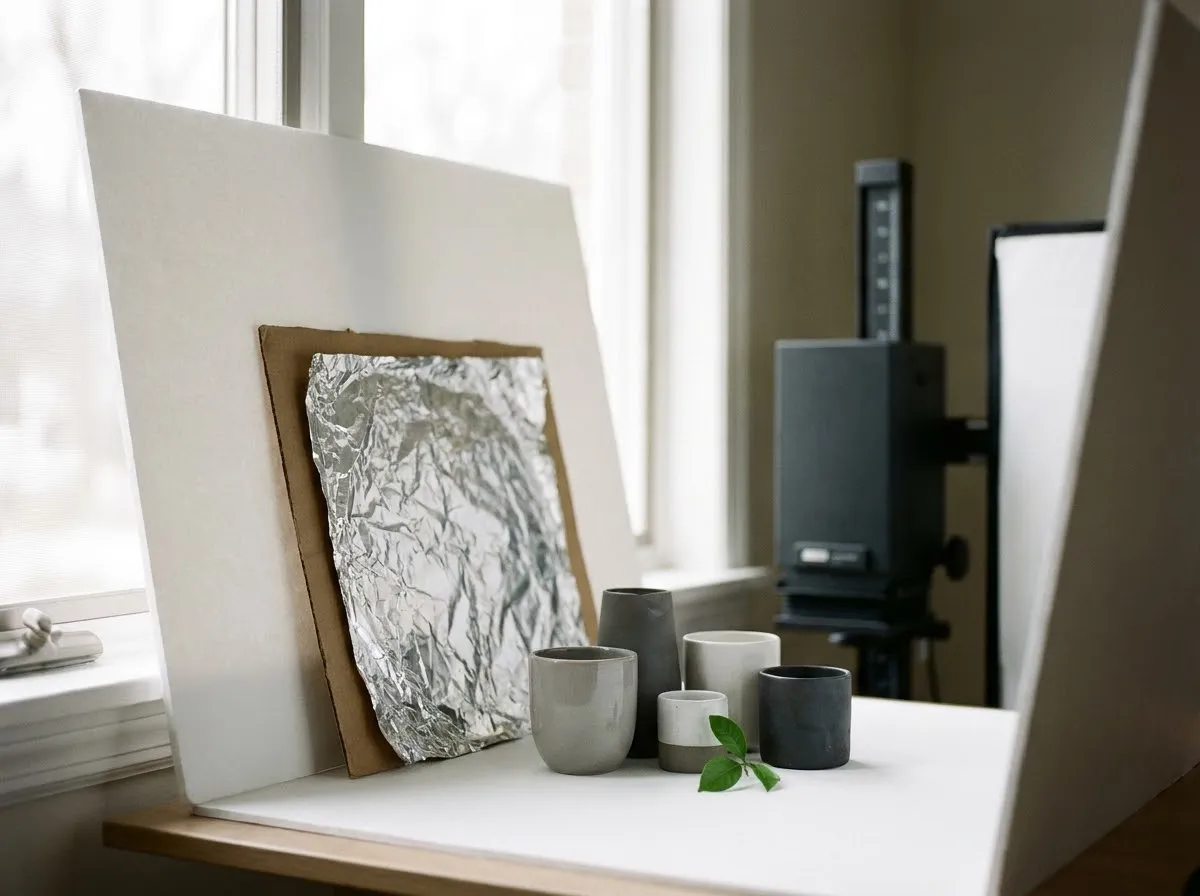
A reflector simply bounces existing light back into your subject’s shadows. The surface texture determines whether the bounced light is soft or punchy:
| Household material | Surface type | Light effect | Best use |
|---|---|---|---|
| White foam core board | Matte white | Soft, neutral fill | Lifting shadows on faces and products |
| Black foam core or poster board | Matte black | Negative fill (absorbs light) | Deepening contrast on the shadow side |
| Crumpled, flattened aluminum foil | Specular silver | Brighter, punchier fill | Bouncing weak window light from farther away |
| White bedsheet or wall | Broad matte | Very soft wrap | Full-body or large tabletop scenes |
- Tip for hands-free bounce: Tape two sheets of white foam core together along one edge with gaffer or masking tape to make a free-standing “V-flat” that stands upright on a desk or floor.
- Distance matters: By the inverse square law, moving a foam board a few inches closer to your subject’s cheek dramatically increases how much fill light it returns.
Passive DIY diffusers: softening harsh windows and LEDs
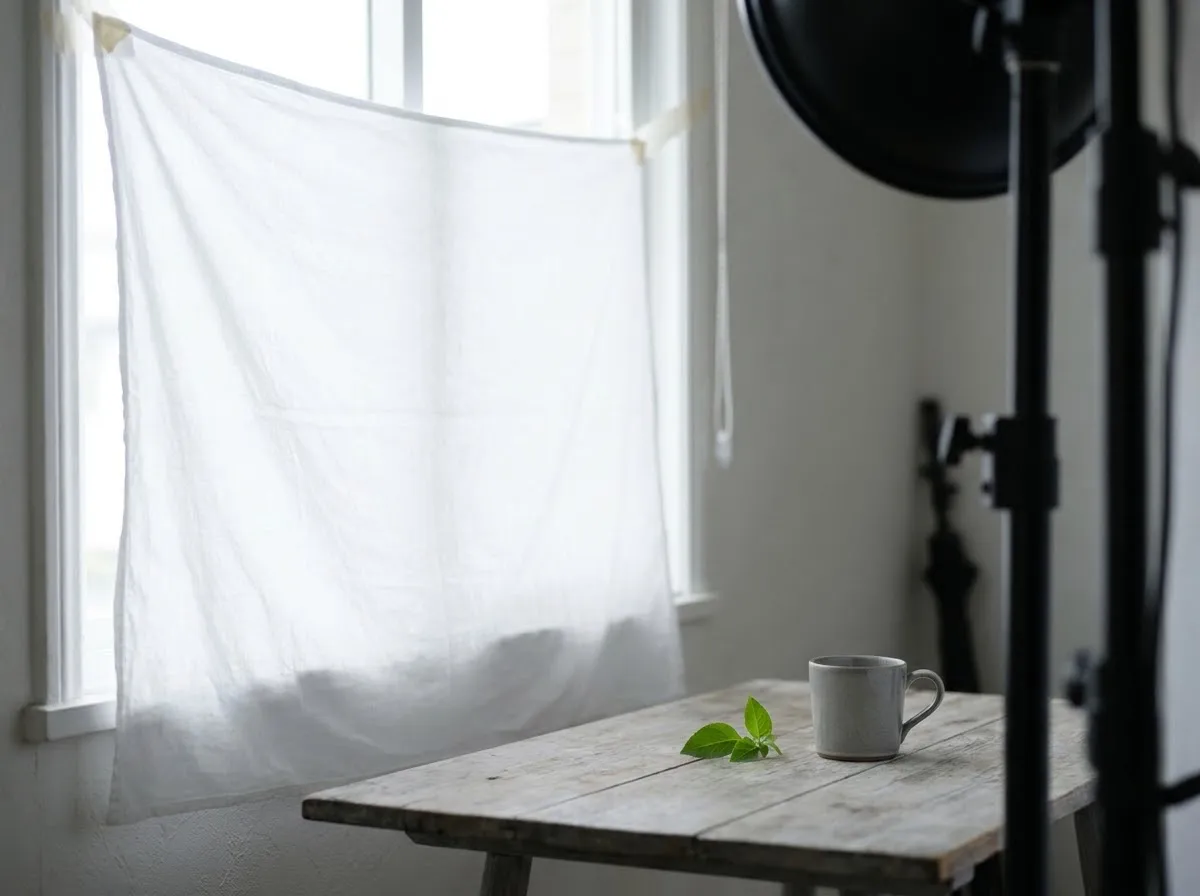
A diffuser sits between the light source and your subject, scattering directional rays across a larger surface area. As explained in hard and soft light differences, making the apparent light source larger relative to the subject widens the shadow edge (penumbra) and softens contrast.
- Sheer white curtains: Hang a plain white sheer curtain over a sunny window to turn harsh direct sun into a broad, soft window light.
- White bedsheet or shower curtain liner: Clip a translucent white sheet across a doorway or between two chairs to create a large scrim for portraits or reflectors and diffusers for natural light.
- Baking parchment or tracing paper: Tape a sheet over a cardboard frame to soften small LED panels or tabletop product lights.
Avoid heavily patterned or off-white/cream fabrics unless you want a warm color cast, and check softbox vs. umbrella if you later want a dedicated collapsible frame.
Safety rules for DIY modifiers around lights
Passive modifiers are safe around daylight windows, but placing paper or fabric near powered fixtures requires strict clearance:
- Never block vents or touch hot lenses: Manufacturer safety manuals (such as Aputure’s amaran safety instructions) warn against placing combustible materials near fixtures, covering cooling vents, or touching hot lamp surfaces.
- Use a separate stand or clamp: Hold DIY diffusers on a chair back, broomstick, or separate stand several feet in front of an LED rather than taping paper directly onto the housing.
- Keep it strictly passive: Do not wire household sockets, dimmers, or bare bulbs into makeshift housings. Stick to certified photo/video lights and follow the maker’s manual.
Checked by Fiat Lux Guides’ editorial desk against the cited sources. Read our sourcing and review approach for how we verify specifications.
Common questions
What is the best household material for a DIY photography reflector?
Matte white foam core board is the most versatile DIY reflector because it stands upright on a table, weighs almost nothing, and bounces neutral, soft fill light onto a subject's shadow side without adding unwanted color casts or harsh specular hotspots.
Does aluminum foil work as a reflector?
Yes, crumpled and flattened aluminum foil taped to cardboard creates a bright, punchy specular reflector similar to a silver bounce card. Because foil produces sharper highlights and more contrast than white foam board, it works best as a subtle rim accent or when you need extra bounce output from a weak window.
What household materials work safely as a light diffuser?
Sheer white polyester curtains, unbleached white bedsheets, ripstop nylon, or translucent baking parchment work well for diffusing window light or cool LEDs placed at a safe distance. Avoid colored fabrics that tint skin tones, and never drape fabric directly over a hot light head.
Can I use DIY modifiers with studio strobes or hot lamps?
Only if you maintain generous air clearance and follow the fixture manufacturer's safety manual. Hot tungsten lamps, halogen modeling bulbs, and high-wattage LED lenses can scorch paper or melt synthetic fabric on contact. Keep passive DIY diffusers on separate stands well away from the lamp housing.
Can I build my own DIY LED or mains-powered light fixture from household parts?
No—stick strictly to passive modifiers like bounce boards and window scrims. Building your own mains-powered lamps or modifying electrical cords carries shock and fire risks. Always use certified lighting gear, follow the maker's instructions, and consult a licensed electrician for any mains wiring.
What we checked
- Aputure Help Center — amaran 60d S Safety Guidelines (checked 2026-11-14) (help.aputure.com)
- Zoner Photo Studio — Hard vs. Soft Light (checked 2026-11-14) (learn.zoner.com)
- HyperPhysics — Inverse Square Law (checked 2026-11-14) (hyperphysics.gsu.edu)
You might also like
- LED vs Strobe vs Speedlight: What to Start With
Compare continuous LED lights, camera speedlights, and studio strobes by output units, shutter sync, color control, and video use to pick your first light.
- Battery vs Mains-Powered Lights for Photo and Video
Compare battery and AC mains-powered photo and video lights on output limits, runtime, cable safety, portability, and fan noise before you buy.
- Bi-Color vs RGB LED Lights: What Each Does
Bi-color vs RGB LED lights compared on CCT range, white-light brightness, CRI/TLCI accuracy, green-magenta tint, and creative color modes.
- Budget Photo and Video Lighting Kit Guide
Build a budget photo and video lighting kit around one key light, a modifier, and a stand. Compare starter kit categories by output and control.
- Continuous LED Lights for Beginners
Learn how continuous LED video and photo lights work, how CRI and TLCI ratings affect color accuracy, and how to compare panel and COB fixtures.
- Flash Guide Number Explained
How flash guide numbers work: the GN = distance x f-number formula, meters vs feet, zoom head effects, ISO scaling, and power steps.