Light Modifiers Explained: Softboxes, Umbrellas, Reflectors
Author: Fiat Lux Guides Editorial Team Reviewer: Fiat Lux Guides Editorial Team Most recently reviewed First published Filed under Lighting Gear
Light modifiers change the apparent size, direction, and softness of a bare bulb or flash head. Softboxes enclose the light for directional control and minimal wall spill, umbrellas spread soft light widely at low cost, and 5-in-1 reflectors bounce or diffuse existing light without needing extra power.
Belongs to the guide: LED vs Strobe vs Speedlight: What to Start With
A bare flash tube or LED chip is small, bright, and unforgiving—it casts sharp, high-contrast shadows. As we explain in our Which light type to buy first pillar guide, the light body generates photons, but light modifiers determine how that light looks on your subject. By enlarging the emitting area, redirecting stray rays, or bouncing light back into shadows, softboxes, umbrellas, and reflectors turn a harsh point source into controlled, flattering illumination.
Why modifier size and distance control softness
Softness is not an intrinsic property of a fabric brand; it is geometry. A light source looks softer when it occupies a larger angular size from the subject’s point of view. A 90 cm softbox placed 1 meter from a subject wraps light around facial contours with a gradual shadow edge, whereas the exact same softbox moved 4 meters away acts much more like a small, hard source.
Distance also governs brightness falloff under the HyperPhysics inverse-square law. Whenever you move a modifier closer to soften shadows, you also increase subject illuminance rapidly and must dial down fixture power or adjust camera exposure. Check our light distance exposure calculator and hard light vs soft light guide to see how distance and size interact.
Before you buy, check how large a modifier looks from your shooting distance with the softbox size and distance calculator.
Softboxes vs umbrellas vs reflectors at a glance
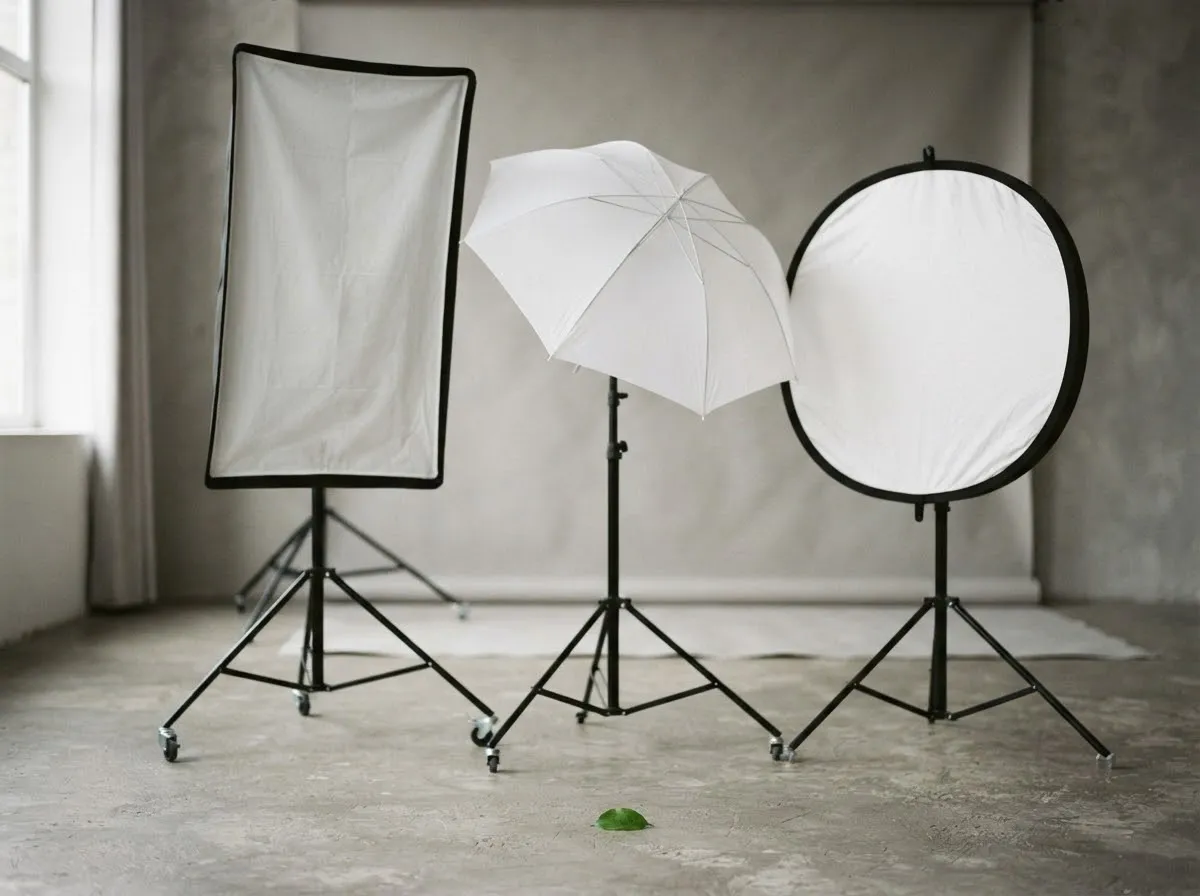
| Modifier Type | Light Spread & Spill | Shadow Quality | Setup & Portability | Best Use Case |
|---|---|---|---|---|
| Softbox (Rect / Octa) | Contained, directional; accepts grids | Very soft, even across front baffle | Moderate; quick-fold models pack flat | Small rooms, portraits, YouTube key light |
| Shoot-Through Umbrella | Very wide (~180°); high wall spill | Soft, wrap-around | Fastest setup; packs like a rain umbrella | Open spaces, tight budgets, group fill |
| Reflective Umbrella (White/Silver) | Wide to medium; less rear spill | Soft (white) to crisp (silver) | Fast setup; lightweight | On-location speedlights, portrait fill |
| 5-in-1 Collapsible Reflector | Passive bounce or 1-stop diffusion | Soft fill (white), crisp (silver), warm (gold) | Folds to about a third of its size; needs stand or holder | Window-light fill, outdoor portraits, negative fill |
How softboxes work and when to choose one
A softbox is an enclosed, collapsible housing with a reflective interior and one or two layers of front diffusion fabric. Light fires into the housing, bounces off the silver or white interior walls, and exits through the front baffle. Because the side walls are opaque, stray light stays inside the box instead of splashing onto your ceiling or background.
- Rectangular and square softboxes: Easy to feather (aim slightly past the subject) and mimic the look of a rectangular window.
- Octagonal softboxes (octaboxes): Create round, natural-looking catchlights in a subject’s eyes.
- Strip boxes: Narrow rectangular boxes used for edge lighting, rim lights, or sleek reflections on bottles and glass.
- Grids (egg crates): Fabric grids attach to the front lip of a softbox to narrow the beam angle, keeping light off the backdrop in tight rooms.
As noted on Westcott’s umbrella-softbox line, modern umbrella-style and quick-fold softboxes open in seconds like an umbrella while keeping the directional control of a traditional speedring softbox. Many studio LEDs and strobes use a Bowens S-mount, such as the mount standard on Aputure’s Bowens fixtures, which lets one modifier fit multiple lights.
How umbrellas work: shoot-through vs reflective
Umbrellas are the simplest and least expensive way to make a small speedlight or bulb into a large source. They slide directly into an umbrella socket on a light stand bracket.
- Shoot-through (translucent) umbrellas: You point the light through the white fabric toward your subject. Because you can place the umbrella very close to the subject without the stand pole getting in the way, it produces very soft light—at the cost of spraying spill light backward and sideways across the entire room.
- Reflective umbrellas (white or silver interior with black backing): You point the light away from the subject into the umbrella bowl, which bounces light forward. Black backing blocks rear spill, giving you slightly better control than a shoot-through umbrella. White interiors give soft, even fill; silver interiors punch slightly farther with crisper highlights.
How 5-in-1 reflectors and diffusers work
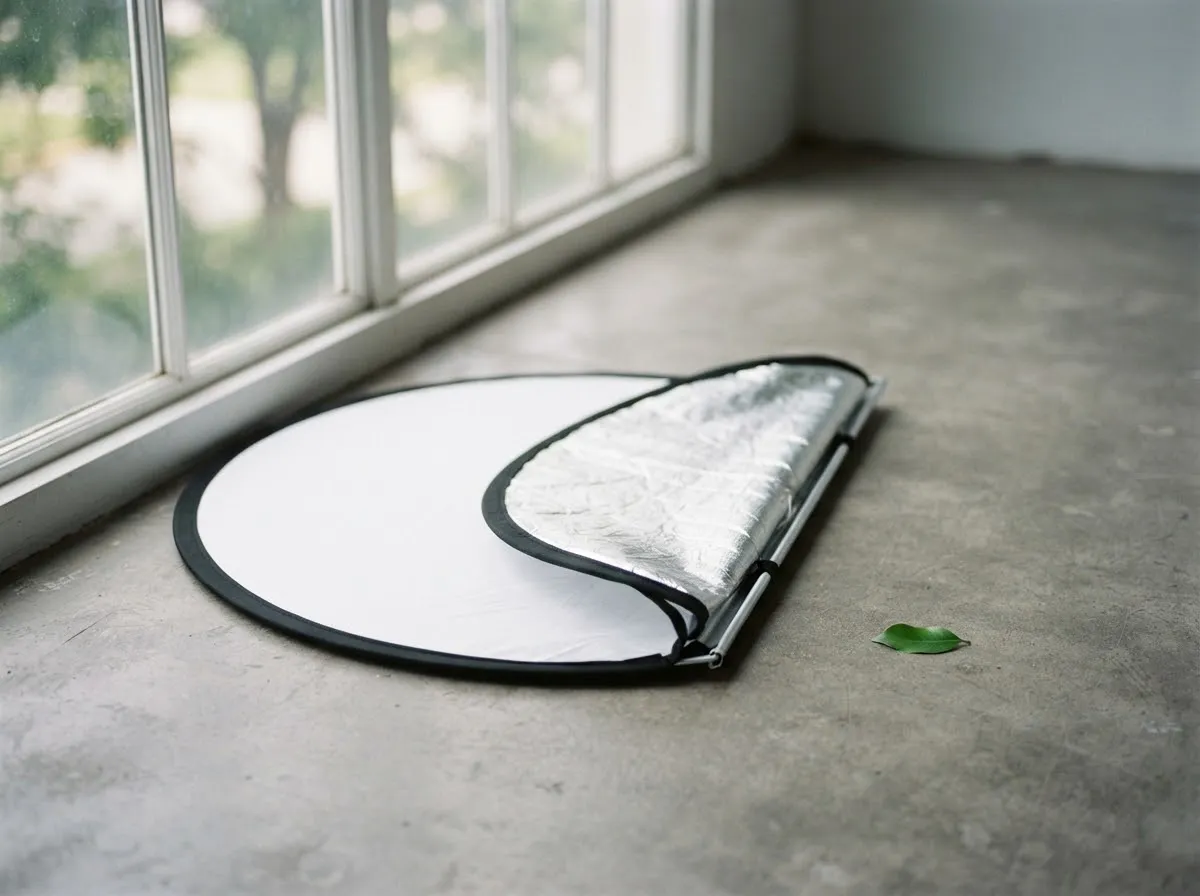
A collapsible 5-in-1 reflector uses a collapsible steel frame with a diffusion disc and a reversible cover. According to Westcott’s Illuminator 5-in-1 specifications, each of the surfaces serves a distinct lighting job:
- Full-stop diffusion: Held between harsh sunlight or a bare lamp and your subject, it scatters direct rays into soft, even light.
- White: Bounces soft, color-neutral fill into shadows without shifting skin tone.
- Silver: Reflects more light efficiently from farther away, adding contrast and crisp highlights.
- Gold (or sunlight): Warms shadow fill, useful when balancing cool shade or matching late-afternoon warmth.
- Black block: Absorbs stray bounce light from nearby white walls to create negative fill and deeper shadow contrast.
Which modifier should you buy first?
If you shoot indoors in a normal bedroom or home office, start with a 60 to 90 cm quick-fold softbox paired with a 5-in-1 reflector. The softbox prevents light from bouncing uncontrollably off white walls, and the reflector handles shadow fill on the opposite side of the face. If you shoot outdoors or travel light with a budget lighting kit built around a speedlight, a convertible umbrella plus a 5-in-1 reflector packs smaller and sets up in under a minute.
Follow the manufacturer’s manual for heat and ventilation clearances when attaching fabric modifiers to continuous lamps or modeling lights, and read our verification process to see how we check equipment specifications.
| Modifier Type | Light Spread & Spill | Shadow Quality | Setup & Portability | Best Use Case |
|---|---|---|---|---|
| Softbox (Rect / Octa) | Contained, directional; accepts grids | Very soft, even across front baffle | Moderate; quick-fold models pack flat | Small rooms, portraits, YouTube key light |
| Shoot-Through Umbrella | Very wide; high wall spill | Soft, wrap-around | Fastest setup; packs like a rain umbrella | Open spaces, tight budgets, group fill |
| Reflective Umbrella (White/Silver) | Wide to medium; less rear spill | Soft (white) to crisp/contrasty (silver) | Fast setup; lightweight | On-location speedlights, portrait fill |
| 5-in-1 Collapsible Reflector | Passive bounce or 1-stop diffusion | Soft fill (white), crisp (silver), warm (gold) | Folds to about a third of its size; needs stand or holder | Window-light fill, outdoor portraits, negative fill |
Choose a softbox when shooting in a small room where wall spill washes out contrast. Choose an umbrella for fast, inexpensive setup in larger spaces, and keep a 5-in-1 reflector in every bag for free shadow fill.
Common questions
What does a softbox do to a light?
A softbox enlarges the effective light-emitting surface and passes the beam through one or two layers of translucent diffusion fabric. Because the sides of the softbox are opaque and lined with reflective material, it directs light forward toward the subject while blocking stray light from bouncing off nearby walls and ceilings.
Is a softbox or an umbrella better for beginners?
A softbox is usually better if you shoot in a small bedroom or home office because its enclosed sides keep light off the background and nearby walls. An umbrella is faster to set up and costs less, making it a strong choice when you have plenty of room or need a lightweight travel kit.
What is the difference between a diffuser and a reflector?
A diffuser sits between the light source and the subject to scatter light and enlarge the apparent source, softening shadows. A reflector sits on the opposite or side angle to bounce existing light back into the shadow side of the subject, reducing contrast without adding a second powered light.
When should I use the silver vs white vs gold side of a reflector?
Use the white surface for soft, color-neutral fill that looks natural on skin. Use the silver surface when you need stronger fill from farther away or slightly higher contrast and specular highlights. Use the gold (or sunlight) surface sparingly to add warmth to cool shade or outdoor portraits.
What does the black surface on a 5-in-1 reflector do?
The black surface acts as a flag or negative fill. Instead of bouncing light into shadows, it absorbs ambient light reflecting off bright nearby walls or ceilings, deepening the shadow side of a face or product to add shape, depth, and contrast.
What we checked
- F.J. Westcott Mega JS Apollo Softbox (collapsible umbrella-style softbox), checked 2026-11-14 (fjwestcott.com)
- F.J. Westcott Illuminator QuickGrip 5-in-1 Reflector Specifications, checked 2026-11-14 (fjwestcott.com)
- Aputure LS 300x Specifications (Bowens-S Mount), checked 2026-11-14 (aputure.com)
- HyperPhysics (Georgia State) — Inverse Square Law, checked 2026-11-14 (hyperphysics.gsu.edu)
You might also like
- LED vs Strobe vs Speedlight: What to Start With
Compare continuous LED lights, camera speedlights, and studio strobes by output units, shutter sync, color control, and video use to pick your first light.
- Battery vs Mains-Powered Lights for Photo and Video
Compare battery and AC mains-powered photo and video lights on output limits, runtime, cable safety, portability, and fan noise before you buy.
- Bi-Color vs RGB LED Lights: What Each Does
Bi-color vs RGB LED lights compared on CCT range, white-light brightness, CRI/TLCI accuracy, green-magenta tint, and creative color modes.
- Budget Photo and Video Lighting Kit Guide
Build a budget photo and video lighting kit around one key light, a modifier, and a stand. Compare starter kit categories by output and control.
- Continuous LED Lights for Beginners
Learn how continuous LED video and photo lights work, how CRI and TLCI ratings affect color accuracy, and how to compare panel and COB fixtures.
- Flash Guide Number Explained
How flash guide numbers work: the GN = distance x f-number formula, meters vs feet, zoom head effects, ISO scaling, and power steps.