LED Panel vs Ring Light for Photo and Video
Author: Fiat Lux Guides Editorial Team Reviewer: Fiat Lux Guides Editorial Team Most recently reviewed First published Filed under Lighting Gear
An LED panel mounts off-axis to sculpt directional shadows and take softboxes or barndoors, while a ring light surrounds your lens for flat, low-shadow frontal fill and circular catchlights. Choose an LED panel for cinematic depth, portraits, and eyeglass wearers; choose a ring light for fast, centered webcam or beauty setups.
Belongs to the guide: LED vs Strobe vs Speedlight: What to Start With
When choosing between an LED panel and a ring light, you are really choosing between directional modeling and flat, centered fill. Inside our LED vs strobe vs speedlight guide cluster, this comparison breaks down how both fixtures shape shadows, catchlights, brightness, and eyeglass reflections so you can pick the right form factor.
LED panel vs. ring light at a glance
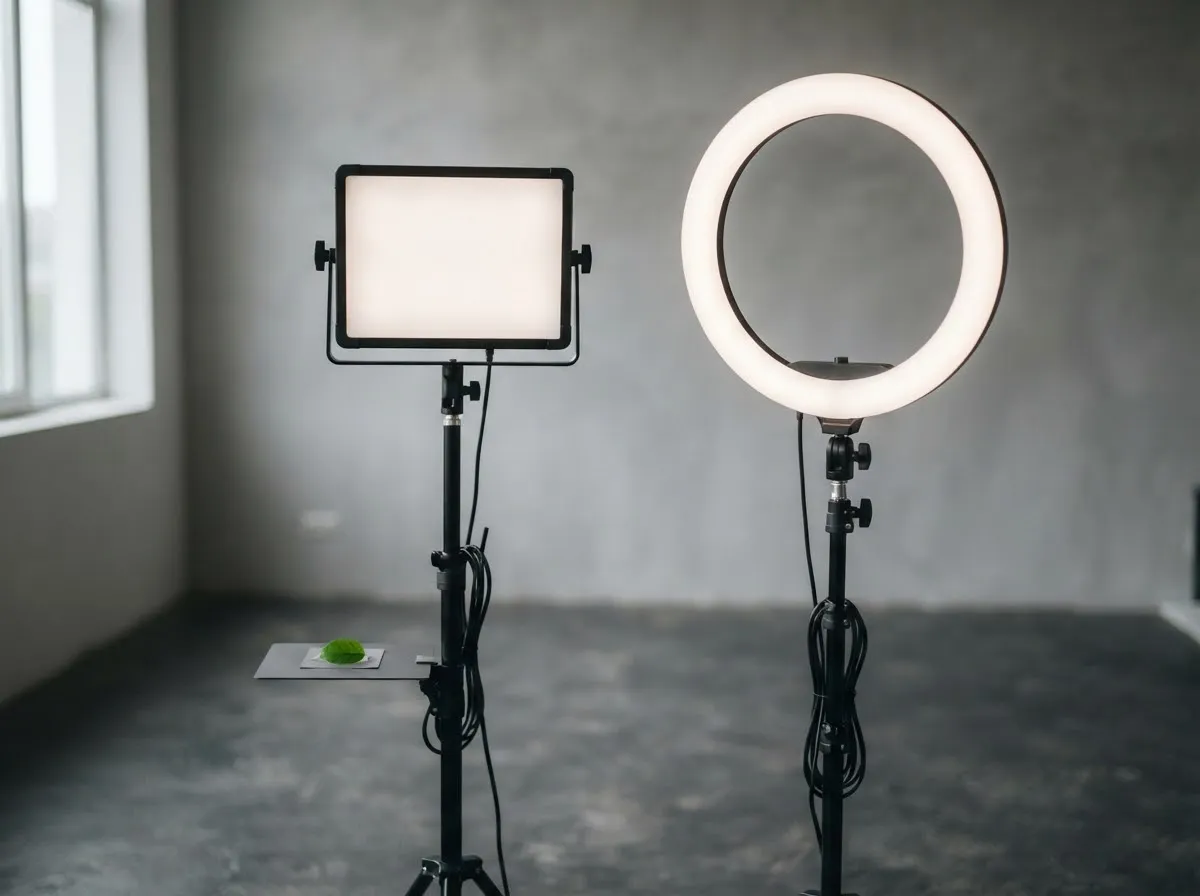
| Attribute | LED panel | Ring light |
|---|---|---|
| Typical placement | Off-axis on a light stand or desk mount | Centered around the camera lens or webcam |
| Shadow character | Directional; shapes cheekbones and depth | Flat, low-shadow frontal fill |
| Eye catchlights | Rectangular window-like reflection | Distinctive circular halo ring |
| Eyeglass glare risk | Low when angled off-axis and raised | High when mounted on-axis around the lens |
| Modifiers & shaping | Softboxes, diffusion frames, barndoors, grids | Usually bare or snap-on plastic diffuser |
| Typical output | Higher lux per watt (e.g., 5,070 lux @ 1 m on 60 W panel) | Moderate close-range output (e.g., 1,510 lux @ 0.5 m) |
How do LED panels and ring lights differ in light quality?
An LED panel produces directional light that creates natural highlights on one side of a face and gentle shadows on the other, whereas a ring light wraps even, nearly shadowless light around the front of the subject.
Because a ring light encircles the camera lens, shadows fall straight behind the subject—just out of view of the sensor. Manufacturers explicitly design ring lights like the Godox Litemons SR20R to give soft, even light and natural catchlights, and the ring shape is what produces a circular catchlight. That look is popular for makeup tutorials, close-up beauty shots, and quick smartphone videos, though it can look flat for narrative video or dramatic portraits.
By contrast, a rectangular panel sits on a light stand or desk clamp to one side of the camera. That off-axis angle reveals facial structure, separates the subject from the background, and mimics the look of a window. You can also soften or narrow a panel with softboxes, grids, or barndoors—covered in light modifiers explained.
Which is brighter and more color-accurate?
Panels are often built for higher output at working distances than ring lights, which makes them easier to diffuse or place farther back from the camera. The two figures below are single examples, not a rule.
Comparing published manufacturer photometrics illustrates the gap:
- LED panel example: The 60 W Aputure amaran P60x outputs 5,070 lux at 1 m (at 5600 K, 45° beam angle), with CRI ≥ 95 and TLCI ≥ 97.
- Ring light example: The Godox Litemons SR20R outputs up to 1,510 lux at 0.5 m (at 5600 K) with CRI/TLCI ≥ 96.
Remember that illuminance drops rapidly as you move a light back under the inverse-square law (HyperPhysics): moving a small source from 0.5 m to 1 m cuts its brightness to roughly one-fourth (the law holds best when the source is small relative to the distance). Check our light distance exposure calculator and softbox softness calculator to see how distance changes both exposure and shadow edge softness.
Why do ring lights reflect in eyeglasses?
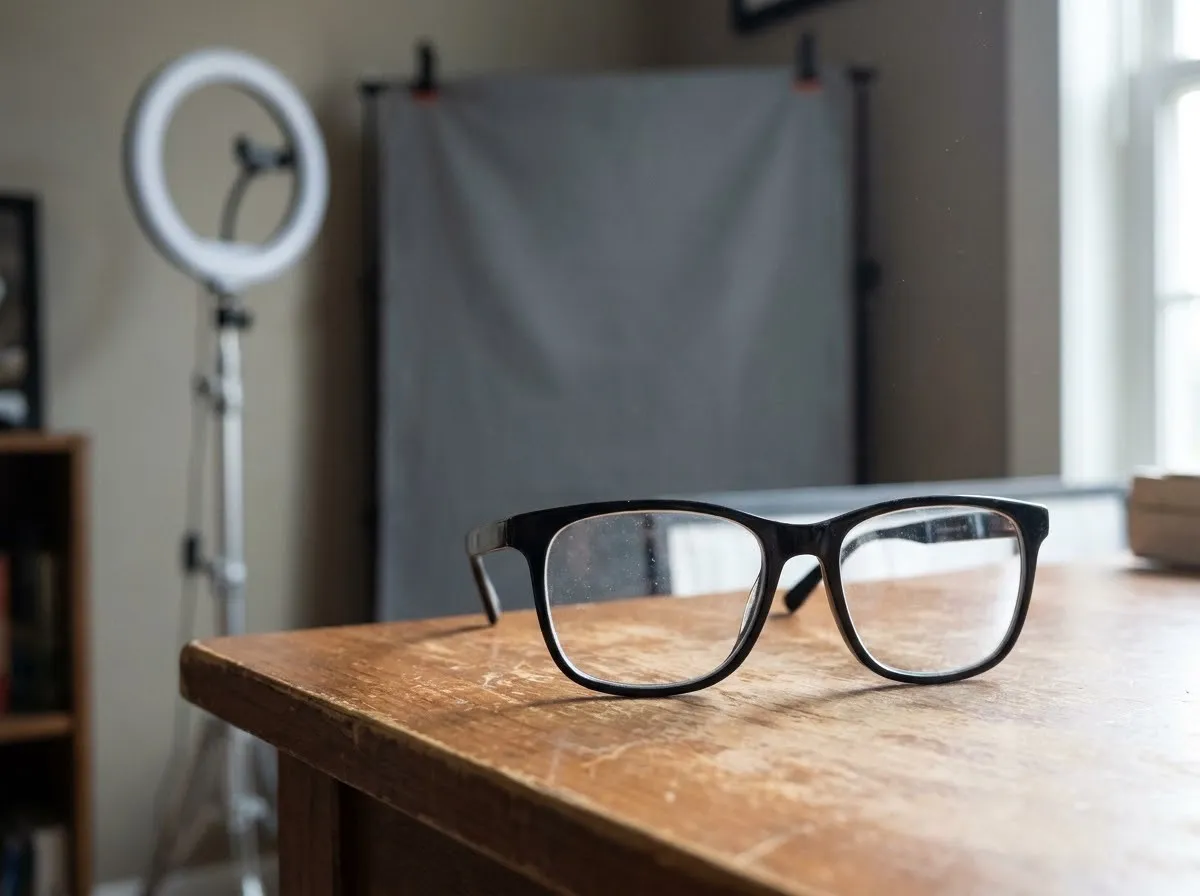
Ring lights sit on or near the camera’s optical axis, so light reflects off flat eyeglass lenses directly back into the camera lens. Under the law of reflection (OpenStax College Physics 2e), the angle of reflection equals the angle of incidence—meaning a light centered in front of the face bounces straight back toward the sensor.
Moving an LED panel off to the side and raising it above eye level angles that reflection downward and away from the lens, eliminating the glowing ring reflection in glasses. If you wear glasses regularly on video call lighting or YouTube lighting setups, an off-axis LED panel is far easier to keep glare-free.
Which should you choose?
- Choose an LED panel if you want natural, three-dimensional facial modeling, wear glasses, plan to add a softbox or grid later, or need enough output to light a desk or small studio from more than arm’s length away. Explore panel options further in continuous LED lights for beginners and bi-color vs RGB LED lights.
- Choose a ring light if you film yourself close-up at a single stand with a phone or webcam, prefer even, low-shadow skin illumination, and specifically want circular catchlights.
Always follow the manufacturer’s manual when mounting and powering AC or battery-operated LED fixtures. For how we verify specifications, see our sourcing rules.
| Attribute | LED panel | Ring light |
|---|---|---|
| Typical placement | Off-axis on a light stand or desk mount | Centered around the camera lens or webcam |
| Shadow character | Directional; shapes cheekbones and depth | Flat, low-shadow frontal fill |
| Eye catchlights | Rectangular window-like reflection | Distinctive circular halo ring |
| Eyeglass glare risk | Low when angled off-axis and raised | High when mounted on-axis around the lens |
| Modifiers & shaping | Softboxes, diffusion frames, barndoors, grids | Usually bare or snap-on plastic diffuser |
| Typical output | Higher output at working distance (e.g., 5,070 lux @ 1 m on a 60 W panel) | Moderate close-range output (e.g., 1,510 lux @ 0.5 m) |
Choose an LED panel if you want natural directional depth, modifier flexibility, or glare-free lighting with glasses. Choose a ring light if you shoot centered smartphone or webcam framing at arm's length and want circular catchlights.
Common questions
Is an LED panel or a ring light better for YouTube and video calls?
An LED panel is more versatile for YouTube and video calls because you can place it off to one side for natural facial depth and keep it away from your camera axis if you wear glasses. A ring light is simpler to set up on a single stand behind a phone or webcam.
Why do ring lights cause glare in glasses?
A ring light typically sits directly around or behind the camera lens, which means light travels straight toward flat eyeglass lenses and reflects directly back into the camera sensor under the law of reflection. Moving an LED panel off-axis and slightly above eye level aims the reflection downward away from the lens.
Which gives softer light: an LED panel or a ring light?
Light softness depends on the apparent angular size of the source from the subject's perspective, not its shape alone. A bare compact LED panel is relatively small and hard-edged until you add a softbox or move it close, whereas a large ring light positioned close to the face wraps light around the nose and cheeks.
Can you use an LED panel for still photography?
Yes, high-CRI continuous LED panels work well for still portraits, tabletop products, and food photography when your subject is stationary or your camera can use a wider aperture or higher ISO. For fast-moving subjects in bright rooms, speedlights or strobes still provide far higher peak output.
Do LED panels and ring lights both let you adjust color temperature?
Most modern bi-color LED panels and ring lights let you dial correlated color temperature (CCT) between warm tungsten and cool daylight, such as 2800 K–6500 K or 3200 K–6500 K. Always check the maker's spec sheet for CRI and TLCI ratings before buying, as budget models vary widely.
What we checked
- Aputure Help Center — amaran P60x & P60c Photometrics & Technical Specifications (checked 2026-11-14) (help.aputure.com)
- Godox — LITEMONS SR20R Full Color LED Light Panel Specifications (checked 2026-11-14) (godox.com)
- OpenStax College Physics 2e — 25.2 The Law of Reflection (checked 2026-11-14) (openstax.org)
- HyperPhysics — Inverse Square Law for Light (checked 2026-11-14) (hyperphysics.phy-astr.gsu.edu)
You might also like
- LED vs Strobe vs Speedlight: What to Start With
Compare continuous LED lights, camera speedlights, and studio strobes by output units, shutter sync, color control, and video use to pick your first light.
- Battery vs Mains-Powered Lights for Photo and Video
Compare battery and AC mains-powered photo and video lights on output limits, runtime, cable safety, portability, and fan noise before you buy.
- Bi-Color vs RGB LED Lights: What Each Does
Bi-color vs RGB LED lights compared on CCT range, white-light brightness, CRI/TLCI accuracy, green-magenta tint, and creative color modes.
- Budget Photo and Video Lighting Kit Guide
Build a budget photo and video lighting kit around one key light, a modifier, and a stand. Compare starter kit categories by output and control.
- Continuous LED Lights for Beginners
Learn how continuous LED video and photo lights work, how CRI and TLCI ratings affect color accuracy, and how to compare panel and COB fixtures.
- Flash Guide Number Explained
How flash guide numbers work: the GN = distance x f-number formula, meters vs feet, zoom head effects, ISO scaling, and power steps.