ND Filters in Bright Light: Stops and Shutter Speed
Author: Fiat Lux Guides Editorial Team Reviewer: Fiat Lux Guides Editorial Team Most recently reviewed First published Filed under Setups and Exposure
A neutral density (ND) filter is darkened optical glass that reduces the light reaching your camera sensor evenly across the frame without changing color. In bright sunlight, ND filters let you keep a slow 180-degree shutter speed for natural video motion blur, shoot at wide apertures like f/1.8 without overexposing, or stay below your camera's flash sync speed.
Belongs to the guide: Three-Point Lighting Explained for Beginners
Neutral density (ND) filters act like calibrated sunglasses for your lens, cutting incoming light by a known number of stops without altering color. In the exposure framework of key, fill and back light setup and outdoor setups, an ND filter is the tool you reach for when the sun is brighter than your desired shutter speed, aperture, or flash sync limit allows.
Decoding ND filter numbers: density, factor, and stops
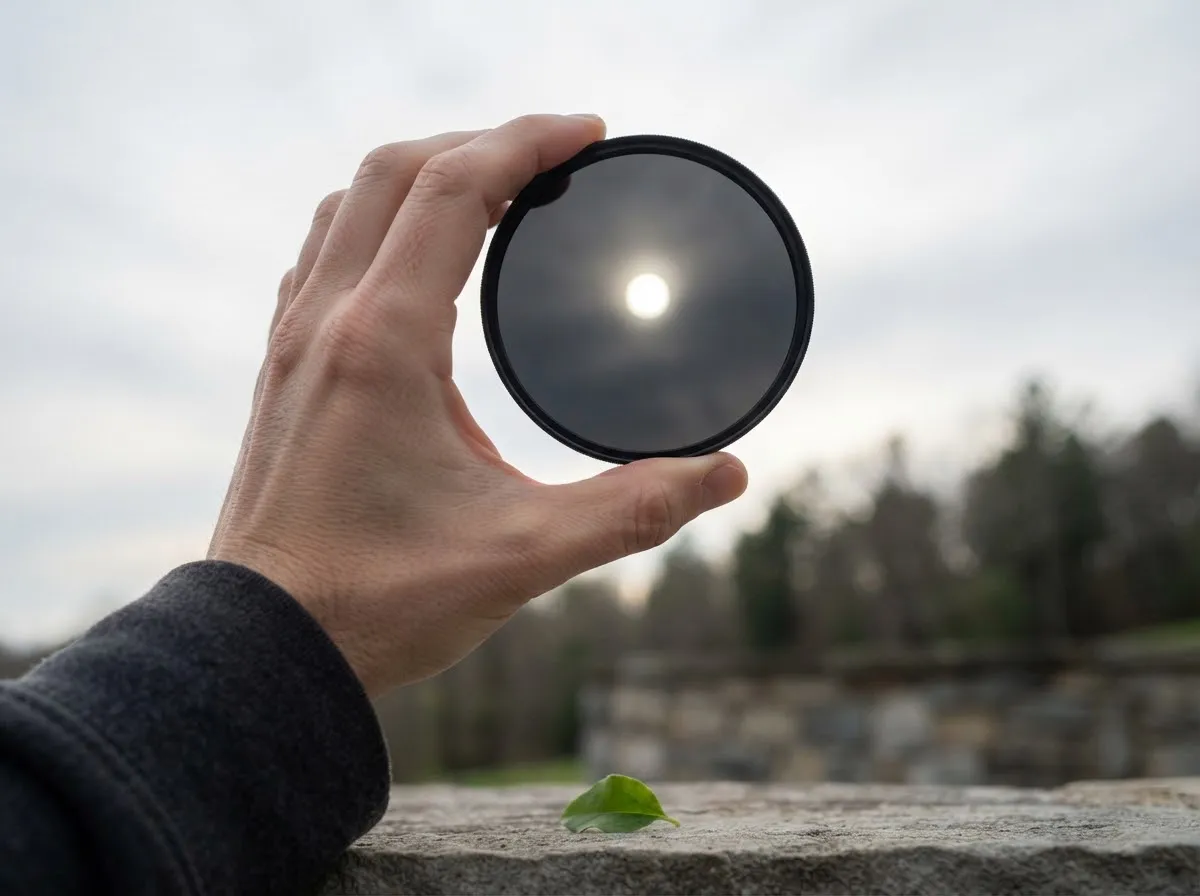
Manufacturers label ND filters using three different systems that all describe the same light reduction, as shown in Hoya’s PROND ratings table:
- Optical density (0.3, 0.6, 0.9, 1.2, 3.0): Every 0.3 increment equals 1 full stop. Divide the density by 0.3 to get the stop reduction (for example, 1.2 / 0.3 = 4 stops).
- Filter factor (ND2, ND4, ND8, ND16, ND1000): The number tells you how many times longer the shutter speed becomes—ND8 multiplies shutter duration by 8 (3 stops), while Hoya’s PROND1000 multiplies exposure by 1,000 (10 stops).
- Stops (EV reduction): Direct stop labels (3-stop, 6-stop, 10-stop) tell you how many clicks of aperture, shutter, or ISO the filter offsets.
For a refresher on how stops work across all exposure controls, see exposure basics for lighting and shutter speed, aperture, ISO, and light.
Three real-world reasons to use an ND filter
- Keeping the 180-degree shutter rule in video: At 24 fps or 30 fps, video cameras typically stay at 1/50 s or 1/60 s for natural motion blur. In bright daylight at ISO 100, that slow shutter speed forces apertures down to f/16 or smaller. Adding a 3-stop to 6-stop ND filter lets you open up to f/2 or f/2.8 for shallow depth of field.
- Shooting wide open in sunlight for portraits: Even in open shade and overcast light, bright days can push a fast f/1.4 or f/1.8 lens past a camera’s fastest mechanical shutter speed (often 1/4000 s or 1/8000 s). A 3-stop ND8 filter brings exposure back inside your shutter range.
- Staying below flash sync speed outdoors: If you use a strobe or speedlight in daylight, your camera’s mechanical sync speed (typically 1/200 s or 1/250 s) prevents wide-open shooting without High-Speed Sync (HSS), which wastes flash power. An ND filter cuts ambient daylight and flash equally, letting you shoot wide open at full strobe power below sync speed—compare both approaches in flash sync speed and high-speed sync and compute strobe distance changes with our light distance exposure calculator.
Fixed ND vs. variable ND filters
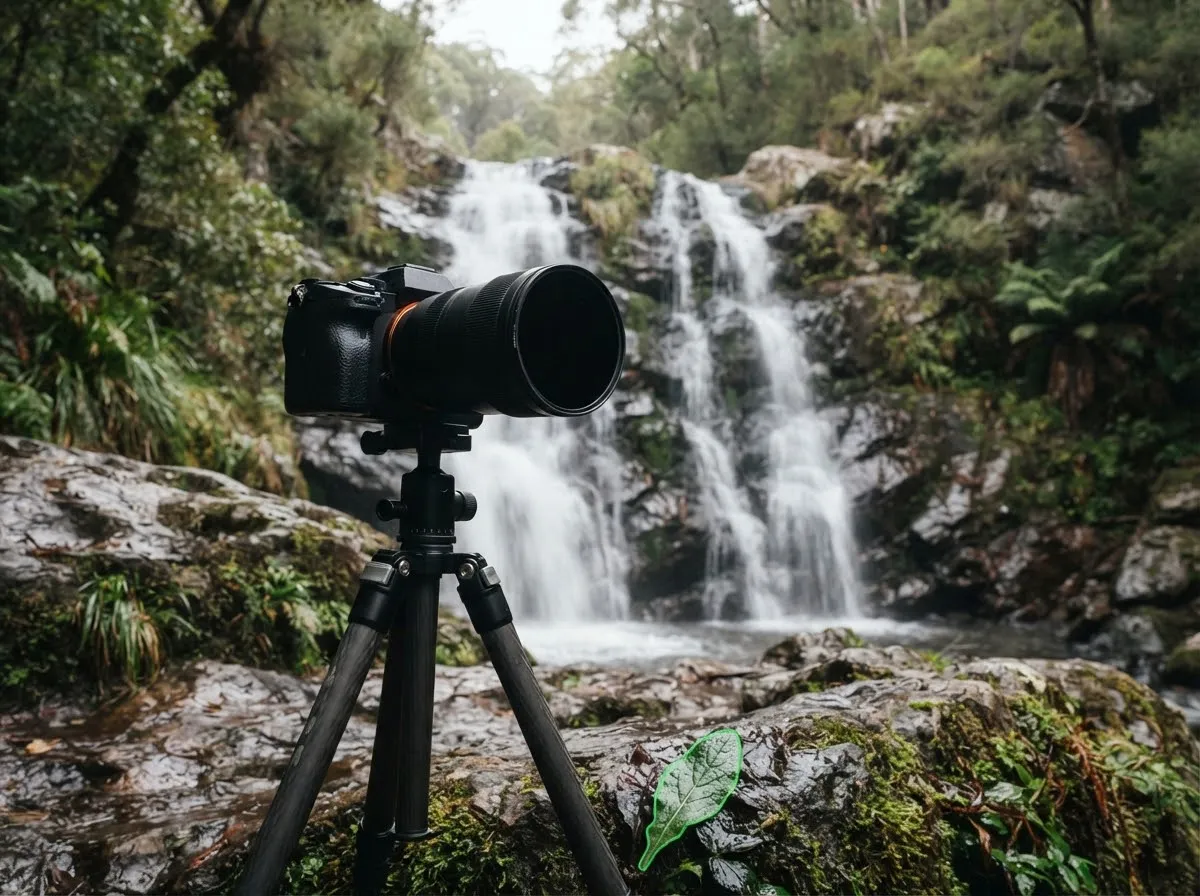
- Fixed (solid) ND filters have a single density (such as ND8 or ND64) and do not use rotating polarizers, so they avoid the X-pattern seen with variable NDs.
- Variable ND filters combine two polarizing films to dial continuously across roughly 2 to 8 stops, as described in Nikon USA’s variable ND video guide. They are fast for run-and-gun video when moving between shade and sun, but Marumi notes the X-shaped unevenness grows as density increases and is more noticeable at wide-angle focal lengths.
Step-by-step exposure calculation with an ND filter
- Meter the scene without the filter (or at the desired aperture and ISO). Suppose bright sun reads 1/1000 s at f/2.8, ISO 100.
- Decide your target shutter speed. For 24 fps video, you want 1/50 s (roughly 4.3 stops slower than 1/1000 s).
- Select the matching ND: A 4-stop (ND16 / 1.2) filter slows 1/1000 s to 1/60 s; a 5-stop (ND32 / 1.5) filter slows it to 1/30 s (or 1/60 s at f/2).
- Mount the filter and verify with your histogram or spot meter before recording.
For how Fiat Lux Guides verifies optical specifications, see our fact-checking process.
| Filter factor | Optical density | Exposure reduction | Light transmittance |
|---|---|---|---|
| ND2 | 0.3 | 1 stop | 50% |
| ND4 | 0.6 | 2 stops | 25% |
| ND8 | 0.9 | 3 stops | 12.5% |
| ND16 | 1.2 | 4 stops | 6.25% |
| ND32 | 1.5 | 5 stops | 3.13% |
| ND1000 | 3.0 | 10 stops | 0.1% |
Common questions
How do you convert optical density to stops on an ND filter?
Divide the optical density number by 0.3 (or multiply by 3.33). Each 0.3 step equals 1 stop of exposure reduction: 0.3 is 1 stop, 0.6 is 2 stops, 0.9 is 3 stops, 1.2 is 4 stops, and 3.0 is 10 stops. Filter factor notation (ND8, ND64, ND1000) shows the exposure multiplier rather than the optical density.
Why do video shooters need ND filters in daylight?
Video looks most natural when the shutter speed stays near double the frame rate—such as 1/50 second at 24 fps or 1/60 second at 30 fps. In bright sun at base ISO, that slow shutter speed requires stopping down to f/16 or f/22, losing background blur. An ND filter cuts the excess light so you can shoot at f/2 or f/2.8.
When should I use an ND filter instead of High-Speed Sync (HSS) with flash?
Use an ND filter when you need full flash power outdoors. High-Speed Sync lets you raise shutter speed past your camera's sync limit, but it reduces effective flash output. A 3-stop or 4-stop ND filter brings your shutter speed back below sync speed so the strobe fires at full energy.
What is the downside of a variable ND filter compared to a fixed ND?
A variable ND filter combines two polarizing films, as Marumi describes, and an X-shaped unevenness appears in the picture as the density increases. Marumi says it is more noticeable at wide-angle focal lengths and recommends 24 mm or longer. Fixed ND filters have a single density and do not rely on rotating polarizers.
How much light does a 3-stop ND8 filter block?
An ND8 (0.9 optical density) filter transmits 12.5% of incoming light, blocking 87.5%—equivalent to 3 full stops. In practice, if your base exposure without a filter is 1/1000 second at f/2.8, adding an ND8 filter slows the shutter speed three stops to 1/125 second at the same aperture and ISO.
What we checked
- HOYA PROND32 (ND 1.5) & ND Filters Ratings Table — Hoya Filter, checked 2026-11-14 (hoyafilter.com)
- HOYA PROND1000 (ND 3.0) Specifications — Hoya Filter, checked 2026-11-14 (hoyafilter.com)
- Using Variable Neutral Density Filters to Adjust Exposure in DSLR Video — Nikon USA, checked 2026-11-14 (nikonusa.com)
- Characteristics of Creation Variable ND — Marumi, checked 2026-11-14 (marumi-global.com)
You might also like
- Three-Point Lighting Explained for Beginners
Learn three-point lighting—key light, fill light, and backlight—plus how source size controls shadow softness and how distance and stops control exposure.
- Common Lighting Mistakes in Photo and Video
Spot and fix the most common photo and video lighting mistakes: mixed color casts, flat on-axis light, harsh overhead shadows, and distance falloff.
- Exposure Basics for Lighting: Stops, ISO, Aperture, Power
Understand how stops of light connect aperture, shutter speed, ISO, and flash or LED power so you can adjust lighting exposure accurately.
- Hard Light vs Soft Light: What Changes the Shadows
Compare hard light vs soft light in photography and video: how source size, distance, and penumbra geometry control shadow edge softness.
- Headshot Lighting at Home
Set up clean headshot lighting at home with a window or a single LED or strobe, covering light angle, background separation, and shadow fill.
- The Inverse Square Law of Light for Photographers
Learn how the inverse square law controls light falloff, exposure stops, and background separation in photography and video.